Detailed Design Document: CloudForge Enterprise Cloud Governance Platform
Document Control
| Property | Value |
|---|---|
| Document ID | AE-DDD-001 |
| Version | 2.1 |
| Status | Approved |
| Classification | Internal |
| Created | January 5, 2026 |
| Last Updated | March 20, 2026 |
Author
| Name | Role | |
|---|---|---|
| Liem Vo-Nguyen | Security Architect | [email protected] |
Approvers
| Name | Role | Signature | Date |
|---|---|---|---|
| Admin One | Engineering Lead | [email protected] | Mar 4, 2026 |
| Admin One | Security Director | [email protected] | Mar 4, 2026 |
| Admin One | Principal Architect | [email protected] | Mar 4, 2026 |
Document History
| Version | Date | Author | Changes |
|---|---|---|---|
| 0.1 | Jan 2, 2026 | L. Vo-Nguyen | Initial draft |
| 0.2 | Jan 3, 2026 | L. Vo-Nguyen | Added compliance module design |
| 1.0 | Jan 5, 2026 | L. Vo-Nguyen | First release |
| 1.1 | Feb 14, 2026 | L. Vo-Nguyen | Added Section 3.4 Remediation Dispatcher |
| 1.2 | Feb 20, 2026 | L. Vo-Nguyen | Added Section 3.5 AI Governance Module (merged from AgentGuard) |
| 1.3 | Feb 25, 2026 | L. Vo-Nguyen | Added Section 3.6 IaC Deploy Layer |
| 2.0 | Feb 27, 2026 | L. Vo-Nguyen | Added Section 3.7 Risk Intelligence (Planned); SLA updates; version bump |
| 2.1 | Mar 20, 2026 | L. Vo-Nguyen | Rename sweep: CloudForge to CloudForge; OPA namespace cloudforge.ai to aegis.ai |
Related Documents
| Document | Link |
|---|---|
| High-Level Design | HLD.md |
| Component Rationale | component-rationale.md |
| DR/BC Plan | DR-BC.md |
| API Specification | openapi.yaml (OpenAPI 3.1, 89 operations) |
1. Introduction
1.1 Purpose
This Detailed Design Document (DDD) provides comprehensive technical specifications for implementing the CloudForge Enterprise Cloud Governance Platform. It supplements the High-Level Design (HLD) with implementation-level details.
1.2 Scope
This document covers:
- Detailed component specifications
- Data models and schemas
- API contracts
- Integration patterns
- Security implementation details
- Performance requirements
1.3 Audience
- Development Engineers
- DevOps/SRE Engineers
- Security Engineers
- QA Engineers
2. System Context
2.1 External Integrations
ASCII fallback
┌─────────────────────────────────────────────────────────────────────────────┐
│                           CloudForge                                         │
└─────────────────────────────────────────────────────────────────────────────┘
         │              │              │              │              │
         ▼              ▼              ▼              ▼              ▼
    ┌─────────┐   ┌─────────┐   ┌─────────┐   ┌─────────┐   ┌─────────┐
    │   VCS   │   │  SAST   │   │   IdP   │   │   GRC   │   │  Cloud  │
    │ GitHub  │   │ Sonar   │   │ Entra   │   │ SNOW    │   │  AWS    │
    │ GitLab  │   │ Veracode│   │ Okta    │   │ Archer  │   │ Azure   │
    │ ADO     │   │ Checkov │   │         │   │         │   │ GCP     │
    └─────────┘   └─────────┘   └─────────┘   └─────────┘   └─────────┘
2.2 Integration Authentication
| System | Auth Method | Credential Storage |
|---|---|---|
| GitHub | OAuth App / PAT | AWS Secrets Manager |
| GitLab | Personal Access Token | AWS Secrets Manager |
| Azure DevOps | PAT / Service Principal | Azure Key Vault |
| SonarQube | API Token | AWS Secrets Manager |
| Veracode | HMAC API Credentials | AWS Secrets Manager |
| Entra ID | OIDC / Client Credentials | Azure Key Vault |
| Okta | API Token / OAuth | AWS Secrets Manager |
| ServiceNow | Basic Auth / OAuth | AWS Secrets Manager |
| Archer | Session Token | AWS Secrets Manager |
| AWS | OIDC Federation (WIF) | None (IAM Roles) |
| Azure | Workload Identity | None (Managed Identity) |
| GCP | Workload Identity | None (Service Account) |
3. Component Detailed Design
3.1 Compliance Framework Engine
3.1.1 Package Structure
internal/compliance/
├── framework.go           # Framework manager and core types
├── finding.go             # Finding schema and methods
├── deduplication.go       # Deduplication logic
├── ai_analyzer.go         # AI-powered analysis
├── frameworks_builtin.go  # CIS, NIST, ISO, PCI-DSS
├── frameworks_sector.go   # HIPAA, SOX, GLBA, FFIEC
├── frameworks_gov_extended.go  # CMMC, ITAR, DFARS
├── frameworks_automotive.go    # ISO 21434, UN ECE R155, TISAX
└── mapper.go              # Finding-to-control mapping
3.1.2 Finding Data Model
type Finding struct {
    // Core Identification
    ID                string          `json:"id"`
    Source            string          `json:"source"`
    SourceFindingID   string          `json:"source_finding_id"`
    Type              FindingType     `json:"type"`
    Category          FindingCategory `json:"category"`

    // Resource Information
    ResourceType      ResourceType    `json:"resource_type"`
    ResourceID        string          `json:"resource_id"`
    ResourceName      string          `json:"resource_name"`

    // Platform & Environment
    Platform          Platform        `json:"platform"`
    CloudProvider     CloudProvider   `json:"cloud_provider"`
    EnvironmentType   EnvironmentType `json:"environment_type"`

    // Severity & Risk
    StaticSeverity    string          `json:"static_severity"`
    AIRiskScore       float64         `json:"ai_risk_score"`
    AIRiskLevel       string          `json:"ai_risk_level"`

    // Workflow
    WorkflowStatus    WorkflowStatus  `json:"workflow_status"`
    Assignee          *AssigneeInfo   `json:"assignee,omitempty"`

    // Compliance
    ComplianceMappings []ComplianceMapping `json:"compliance_mappings"`
}
3.1.3 Deduplication Algorithm
Input: New Finding F, Existing Findings []E

1. Generate DeduplicationKey for F:
   Key = SHA256(ResourceType + ResourceID + CanonicalRuleID + Title + CVEs)

2. Check for exact duplicates:
   FOR each E in existing:
     IF E.DeduplicationKey == F.DeduplicationKey:
       RETURN (F, isDuplicate=true)

3. Check for equivalent rules:
   FOR each E in existing:
     IF E.ResourceID == F.ResourceID:
       IF areRulesEquivalent(E.SourceFindingID, F.SourceFindingID):
         IF shouldReplaceExisting(F, E):
           MARK E for removal
           RETURN (F, isDuplicate=false)
         ELSE:
           F.DuplicateOf = E.ID
           RETURN (F, isDuplicate=true)

4. RETURN (F, isDuplicate=false)
3.1.4 Rule Equivalence Mappings
| Canonical Rule | Equivalent Rules |
|---|---|
| s3-bucket-public-access | S3.1, S3.2, S3.3, CKV_AWS_19, CKV_AWS_20, CKV_AWS_21 |
| ec2-security-group-open | EC2.19, EC2.2, CKV_AWS_23, CKV_AWS_24, CKV_AWS_25 |
| iam-root-access-key | IAM.4, CKV_AWS_41 |
| encryption-at-rest | S3.4, RDS.3, EBS.1, CKV_AWS_3, CKV_AWS_16 |
3.2 CI/CD Security Module
3.2.1 Package Structure
internal/cicd/
├── scanner.go              # Pipeline scanner
├── dependency_scanner.go   # Dependency analysis
├── vcs/
│   ├── provider.go         # VCS interface
│   ├── github.go           # GitHub/GH Enterprise
│   ├── gitlab.go           # GitLab
│   └── azure_devops.go     # Azure DevOps
└── sast/
    ├── provider.go         # SAST interface
    ├── sonarqube.go        # SonarQube/SonarCloud
    ├── checkov.go          # Checkov IaC scanning
    └── veracode.go         # Veracode SAST/DAST
3.2.2 VCS Provider Interface
type Provider interface {
    Name() string
    GetRepositories(ctx context.Context) ([]*Repository, error)
    GetPullRequests(ctx context.Context, owner, repo, state string) ([]*PullRequest, error)
    GetPipelines(ctx context.Context, owner, repo string) ([]*Pipeline, error)
    GetSecurityAlerts(ctx context.Context, owner, repo string) ([]*SecurityAlert, error)
    CreateCheckRun(ctx context.Context, owner, repo, sha string, check *CheckRun) error
}
3.2.3 SAST Provider Interface
type Provider interface {
    Name() string
    Type() string  // sast, dast, sca, iac
    Scan(ctx context.Context, req *ScanRequest) (*ScanResult, error)
    GetScanStatus(ctx context.Context, scanID string) (*ScanStatus, error)
    GetFindings(ctx context.Context, scanID string) ([]*Finding, error)
}
3.3 Identity & Zero Trust Module
3.3.1 Package Structure
internal/identity/
├── provider.go       # Identity provider interface
├── entra_id.go       # Microsoft Entra ID
├── okta.go           # Okta
└── zero_trust.go     # Zero Trust policy engine
3.3.2 Zero Trust Policy Evaluation
type PolicyDecision struct {
    Allow           bool
    RequireMFA      bool
    RequireDevice   bool
    SessionDuration time.Duration
    RiskScore       float64
    Reason          string
}

func (z *ZeroTrustEnforcer) EnforcePolicy(ctx context.Context, req AccessRequest) (*PolicyDecision, error) {
    // 1. Evaluate user risk
    userRisk := z.evaluateUserRisk(req.User)

    // 2. Evaluate device compliance
    deviceCompliance := z.evaluateDeviceCompliance(req.Device)

    // 3. Evaluate resource sensitivity
    resourceSensitivity := z.evaluateResourceSensitivity(req.Resource)

    // 4. Apply policies
    for _, policy := range z.policies {
        if policy.Matches(req) {
            return policy.Evaluate(userRisk, deviceCompliance, resourceSensitivity)
        }
    }

    // 5. Default deny
    return &PolicyDecision{Allow: false, Reason: "No matching policy"}
}
3.4 Remediation Dispatcher
3.4.1 Package Structure
pkg/remediation/
├── executor.go         # Batch executor, semaphore, dry-run routing
├── types.go            # Remediator interface, result types, RollbackState

internal/remediation/
├── network/
│   └── block_ssh.go    # BlockPublicSSHRemediator (Tier 1, AWS/GCP/Azure)
├── compute/            # (planned) EBS encryption, IMDSv2, public AMI handlers
├── identity/           # (planned) IAM root key, stale access key handlers
└── storage/            # (planned) S3 public access, versioning handlers

internal/findings/
└── finding.go          # PrioritizedFinding bridge type consumed by all handlers
3.4.2 Remediator Interface
All remediation handlers implement the Remediator interface defined in
pkg/remediation/types.go. The interface enforces a four-method contract
covering execution, validation, tier classification, and simulation:
// Remediator is the interface that all remediation handlers must implement.
type Remediator interface {
    // Remediate executes the remediation action for the given finding.
    Remediate(ctx context.Context, finding *findings.PrioritizedFinding) (*RemediationResult, error)

    // Validate verifies that the remediation was successful.
    Validate(ctx context.Context, finding *findings.PrioritizedFinding) (*ValidationResult, error)

    // Tier returns the complexity tier (1-3) for this remediation.
    // Tier 1: Auto-safe, no approval needed (DEV/STG)
    // Tier 2: Requires verification before PROD
    // Tier 3: Requires change window
    Tier() int

    // DryRun simulates the remediation without making changes.
    DryRun(ctx context.Context, finding *findings.PrioritizedFinding) (*DryRunResult, error)
}
3.4.3 Finding Bridge Type
The internal/findings package defines the primary type consumed by all
handlers. It mirrors the cspm-aggregator's scoring package schema for JSON
compatibility and will be removed once the aggregator is merged:
// PrioritizedFinding contains the full assessment for a finding.
// This is the primary type consumed by remediation handlers.
type PrioritizedFinding struct {
    Finding              *Finding              `json:"finding"`
    RiskAssessment       *RiskAssessment       `json:"risk_assessment,omitempty"`
    ComplexityAssessment *ComplexityAssessment `json:"complexity_assessment,omitempty"`
    Priority             string                `json:"priority"`
    PriorityScore        int                   `json:"priority_score"`
    AutoRemediationReady bool                  `json:"auto_remediation_ready"`
    RecommendedAction    string                `json:"recommended_action"`
    AssignedQueue        string                `json:"assigned_queue"`
    RequiresApproval     bool                  `json:"requires_approval"`
    AssessedAt           time.Time             `json:"assessed_at"`
}
The Finding.Context struct carries business context — asset tier, environment
type, data classification, internet-facing flag, and compliance scopes — that
is used by handlers for bastion-host heuristics and tier gate decisions.
3.4.4 Tiered Execution Model
Remediation actions are classified into three tiers that gate execution authority:
| Tier | Name | Auto-Execute | Approval Required | Scope |
|---|---|---|---|---|
| T1 | Auto-safe | Yes | None | Always runs; changes are always safe (e.g., block public SSH on non-bastion) |
| T2 | Requires verification | Only if AutoRemediationReady=true | Pre-PROD review | Moderate blast radius; validated before applying to production |
| T3 | Change window | No | Full change approval | High blast radius; requires scheduled change window |
The executor enforces this gate at the Execute method level:
// Tier 1 = auto-safe (always runs). Tier 2+ require AutoRemediationReady [SEC-006]
if !finding.AutoRemediationReady && handler.Tier() > 1 {
    return &RemediationResult{
        FindingID: finding.Finding.ID,
        Success:   false,
        Message:   fmt.Sprintf("Auto-remediation not approved for tier %d finding", handler.Tier()),
    }, nil
}
3.4.5 Executor Flow
The Executor dispatches findings to registered handlers by FindingType key.
The execution sequence is:
PrioritizedFinding
       |
       v
[Nil guard + field validation]  -- SEC-001: prevents nil pointer panics
       |
       v
[Handler lookup by FindingType]
       |
       v
[Tier gate check]  -- T2/T3 require AutoRemediationReady=true
       |
       v
[Dry-run branch?]
   Yes --> handler.DryRun()  --> RemediationResult{Message: "DRY-RUN: ..."}
   No  --> handler.Remediate()
              |
              v
         handler.Validate()
              |
         IsCompliant?
          Yes --> result.Success = true
          No  --> result.Success = false (remediation applied but validation failed)
The full Execute method applies the sequence including post-remediation
validation:
// Execute processes a finding and routes it to the appropriate handler.
func (e *Executor) Execute(ctx context.Context, finding *findings.PrioritizedFinding) (*RemediationResult, error) {
    if finding == nil || finding.Finding == nil {
        return nil, fmt.Errorf("finding or finding.Finding is nil")
    }
    if finding.Finding.ID == "" || finding.Finding.FindingType == "" {
        return nil, fmt.Errorf("finding missing required fields: ID=%q, FindingType=%q",
            finding.Finding.ID, finding.Finding.FindingType)
    }

    handler, ok := e.handlers[finding.Finding.FindingType]
    if !ok {
        return nil, fmt.Errorf("no handler registered for finding type: %s", finding.Finding.FindingType)
    }

    if !finding.AutoRemediationReady && handler.Tier() > 1 {
        return &RemediationResult{
            FindingID: finding.Finding.ID,
            Success:   false,
            Message:   fmt.Sprintf("Auto-remediation not approved for tier %d finding", handler.Tier()),
        }, nil
    }

    if e.dryRun {
        dryRunResult, err := handler.DryRun(ctx, finding)
        // ...
    }

    result, err := handler.Remediate(ctx, finding)
    // ...
    validation, err := handler.Validate(ctx, finding)
    // ...
}
3.4.6 Batch Processing with Semaphore
ExecuteBatch processes multiple findings concurrently up to a configurable
maxConcurrency limit. Results are guaranteed to be returned in input order
regardless of goroutine completion order. Context cancellation is handled
gracefully — remaining items are marked as cancelled rather than deadlocked:
// ExecuteBatch processes multiple findings concurrently (up to maxConcurrency).
// Results are returned in the same order as the input batch [SEC-002].
func (e *Executor) ExecuteBatch(ctx context.Context, batch []*findings.PrioritizedFinding, maxConcurrency int) ([]*RemediationResult, error) {
    if maxConcurrency <= 0 {
        maxConcurrency = 5
    }

    results := make([]*RemediationResult, len(batch))   // pre-allocated at fixed indices
    sem := make(chan struct{}, maxConcurrency)

    type resultPair struct {
        result *RemediationResult
        err    error
        index  int
    }

    resultChan := make(chan resultPair, len(batch))

    for i := range batch {
        select {
        case sem <- struct{}{}:
        case <-ctx.Done():
            // Mark remaining as cancelled; do not block
        }
        go func(idx int, f *findings.PrioritizedFinding) {
            defer func() { <-sem }()
            result, err := e.Execute(ctx, f)
            resultChan <- resultPair{result: result, err: err, index: idx}
        }(i, batch[i])
    }
    // Drain resultChan and place each result at its original index
    // ...
}
Key properties of the batch executor:
- Default concurrency: 5 (configurable via
maxConcurrency) - Context-aware semaphore acquisition prevents goroutine leaks on cancellation
- Index-preserving results enable deterministic audit log ordering
3.4.7 Handler Registration
Handlers are registered against the FindingType string key used in the
finding's FindingType field. Multiple CSP variants can map to the same
handler:
executor := remediation.NewExecutor(false) // false = live mode

sshHandler := network.NewBlockPublicSSHRemediator()
executor.Register("OPEN_SSH_PORT", sshHandler)
executor.Register("AWS.EC2.SecurityGroup.SSH", sshHandler)
executor.Register("GCP.OPEN_SSH_PORT", sshHandler)
The BlockPublicSSHRemediator dispatches internally by CSP based on
finding.Finding.Source:
func (b *BlockPublicSSHRemediator) Remediate(ctx context.Context, finding *findings.PrioritizedFinding) (*remediation.RemediationResult, error) {
    switch {
    case strings.Contains(finding.Finding.Source, "aws"):
        return b.remediateAWS(ctx, finding, result)
    case strings.Contains(finding.Finding.Source, "gcp"):
        return b.remediateGCP(ctx, finding, result)
    case strings.Contains(finding.Finding.Source, "azure"):
        return b.remediateAzure(ctx, finding, result)
    }
}
The AWS path calls ec2.RevokeSecurityGroupIngress to remove the
0.0.0.0/0:22 ingress rule, then validates via ec2.DescribeSecurityGroups
that no public SSH rule remains. The GCP and Azure paths are stubs pending
implementation.
3.4.8 Dry-Run Mode
When NewExecutor(dryRun: true) is configured, every handler receives a
DryRun() call instead of Remediate(). The DryRunResult carries:
WouldSucceed bool— whether the handler believes the action would succeedPlannedActions []string— human-readable list of changes that would be madePrerequisitesMet bool— whether all preconditions are satisfiedEstimatedImpact string— operator-readable impact statementWarnings []string— conditions that block or caution against auto-execution
Example: the SSH handler heuristically detects bastion hosts and suppresses auto-execution:
// Check if this is a bastion security group (heuristic)
if strings.Contains(strings.ToLower(finding.Finding.ResourceID), "bastion") {
    dryRun.Warnings = append(dryRun.Warnings,
        "WARNING: This appears to be a bastion host security group. Public SSH may be intentional.")
    dryRun.WouldSucceed = false
}
3.4.9 Rollback Engine
The RollbackState type captures pre-remediation resource state with a 48-hour
rollback window enforced at the workflow layer:
// RollbackState captures pre-remediation state needed to reverse an action.
type RollbackState struct {
    FindingID  string                 `json:"finding_id"`
    ResourceID string                 `json:"resource_id"`
    Region     string                 `json:"region"`
    AccountID  string                 `json:"account_id"`
    PreState   map[string]interface{} `json:"pre_state"` // Handler-specific state
    CapturedAt time.Time              `json:"captured_at"`
}
PreState is handler-specific — for the SSH handler it stores the original
ingress rules; for future key-rotation handlers it stores the prior key ID.
The rollback window expiry check (CapturedAt.Add(48 * time.Hour).Before(now))
is enforced before allowing rollback execution.
RemediationRecord provides the full audit trail linking findings, handlers,
results, and Asana task URLs:
type RemediationRecord struct {
    ID           string             `json:"id"`
    FindingID    string             `json:"finding_id"`
    Domain       string             `json:"domain"`    // compute, identity, network, etc.
    Handler      string             `json:"handler"`   // Specific remediator name
    Tier         int                `json:"tier"`
    Status       RemediationStatus  `json:"status"`
    Result       *RemediationResult `json:"result,omitempty"`
    Validation   *ValidationResult  `json:"validation,omitempty"`
    AsanaTaskURL string             `json:"asana_task_url,omitempty"`
    CreatedAt    time.Time          `json:"created_at"`
    UpdatedAt    time.Time          `json:"updated_at"`
}
3.4.10 Remediation State Machine
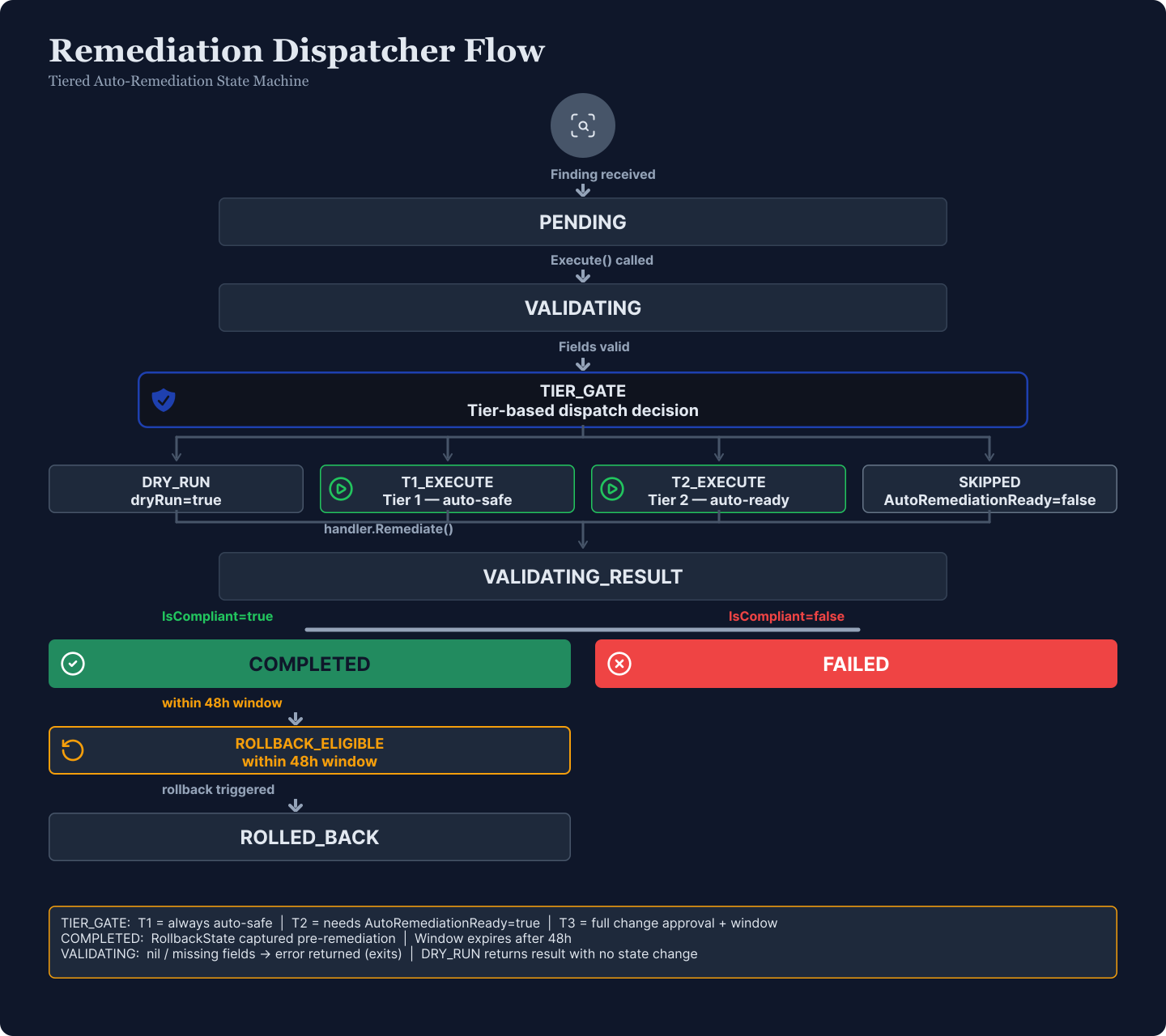
Canonical diagram source:
docs/core/diagrams/remediation-dispatcher-flow.mmd— rendered SVG atremediation-dispatcher-flow.svg.
Valid status values: pending, in_progress, completed, failed, skipped.
3.5 AI Governance Module
3.5.1 Package Structure
internal/ai-governance/
├── opa/
│   └── engine.go       # In-process OPA engine, policy loading, evaluation
└── models.go           # Agent registry, observability traces, STRIDE+ATLAS
                        # threat models, maturity assessment
Migrated selectively from AgentGuard. Compliance framework models
(Framework, Control, Crosswalk, GapAnalysis) are not included here
as they already exist in internal/compliance/.
3.5.2 Dual-OPA Architecture
CloudForge runs two distinct OPA evaluation paths that are architecturally complementary:
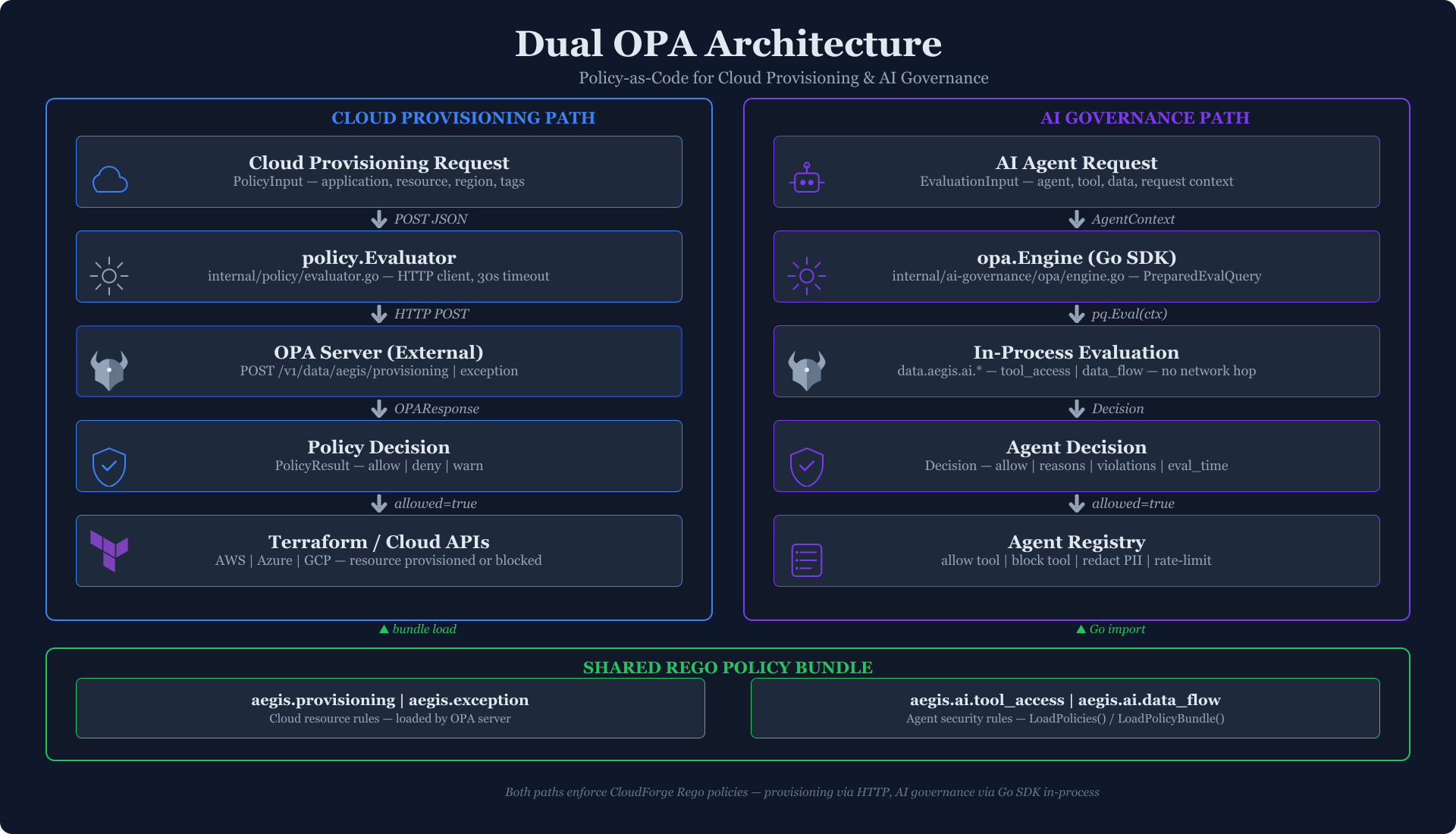
Canonical diagram source:
docs/core/diagrams/dual-opa-architecture.mmd— the Cloud Provisioning path uses HTTP REST to an external OPA instance (terraform.*namespace), while the AI Governance path uses the embedded OPA Go library in-process (aegis.ai.*namespace).
The two paths are independent and non-conflicting: internal/policy/evaluator.go
sends plan JSON to an external OPA HTTP endpoint; internal/ai-governance/opa/engine.go
embeds the OPA Go library directly and evaluates in-process with sub-millisecond
latency requirements for synchronous agent request gating.
3.5.3 Embedded OPA Engine
The Engine type wraps the OPA Go library with a sync.RWMutex-protected
query cache, an in-memory data store, and lazy query preparation:
// Engine is the in-process policy evaluation engine powered by OPA.
type Engine struct {
    mu      sync.RWMutex
    queries map[string]*rego.PreparedEvalQuery
    store   storage.Store
}

// Decision represents the result of a policy evaluation.
type Decision struct {
    Allow      bool           `json:"allow"`
    Reasons    []string       `json:"reasons,omitempty"`
    Violations []Violation    `json:"violations,omitempty"`
    Metadata   map[string]any `json:"metadata,omitempty"`
    EvalTimeUs int64          `json:"eval_time_us"`
}
Policies are loaded either as individual .rego files or as pre-bundled
tar.gz archives. The Rego namespace is data.aegis.ai:
func (e *Engine) LoadPolicies(ctx context.Context, paths []string) error {
    r = rego.New(
        rego.Query("data.aegis.ai"),
        rego.Store(e.store),
        rego.Load([]string{path}, nil),
    )
    pq, err := r.PrepareForEval(ctx)
    e.queries["default"] = &pq
    return nil
}
3.5.4 Evaluation Input Schema
All policy evaluation uses the EvaluationInput struct, which carries typed
contexts for the agent, the tool being invoked, the data being accessed, and
the originating request:
// EvaluationInput is the input to policy evaluation.
type EvaluationInput struct {
    Agent       AgentContext      `json:"agent"`
    Tool        *ToolContext      `json:"tool,omitempty"`
    Data        *DataContext      `json:"data,omitempty"`
    Request     *RequestContext   `json:"request,omitempty"`
    Environment map[string]string `json:"environment,omitempty"`
}

// AgentContext provides agent information for policy evaluation.
type AgentContext struct {
    ID           string   `json:"id"`
    Name         string   `json:"name"`
    Team         string   `json:"team"`
    Environment  string   `json:"environment"`
    Capabilities []string `json:"capabilities"`
}

// ToolContext provides tool invocation information.
type ToolContext struct {
    Name       string         `json:"name"`
    Category   string         `json:"category"`
    Parameters map[string]any `json:"parameters"`
    External   bool           `json:"external"`
}

// DataContext provides data flow information.
type DataContext struct {
    Classification string   `json:"classification"`
    Source         string   `json:"source"`
    Destination    string   `json:"destination"`
    PIIFields      []string `json:"pii_fields,omitempty"`
}
Two convenience methods are exposed for the two primary policy domains:
// EvaluateToolAccess evaluates tool access policy for an AI agent.
func (e *Engine) EvaluateToolAccess(ctx context.Context, agent *AgentContext, tool *ToolContext) (*Decision, error) {
    input := &EvaluationInput{Agent: *agent, Tool: tool}
    return e.Evaluate(ctx, "aegis.ai.tool_access.allow", input)
}

// EvaluateDataFlow evaluates data flow policy for an AI agent.
func (e *Engine) EvaluateDataFlow(ctx context.Context, agent *AgentContext, data *DataContext) (*Decision, error) {
    input := &EvaluationInput{Agent: *agent, Data: data}
    return e.Evaluate(ctx, "aegis.ai.data_flow.allow", input)
}
3.5.5 Built-in Rego Policies
Two base policies are embedded as Go constants. Both are loaded at engine initialization and can be overridden by environment-specific bundles.
Tool Access Policy (package aegis.ai.tool_access):
- Default deny; allow requires tool in allowed list, parameters passing forbidden-pattern regex check, and no rate-limit breach
- Generates typed
denial_reasonsfor audit logs
package aegis.ai.tool_access

default allow = false

allow {
    tool_allowed
    parameters_valid
    not rate_limit_exceeded
}

tool_allowed {
    input.tool.name in data.policies.allowed_tools[input.agent.id]
}

contains_forbidden_pattern {
    pattern := data.policies.forbidden_patterns[_]
    regex.match(pattern, json.marshal(input.tool.parameters))
}
Data Flow Policy (package aegis.ai.data_flow):
- Controls which data classifications may flow to which destinations
- PII data to
redact_destinationstriggers field-level redaction source_restrictedcheck blocks flows from restricted sources to untrusted destinations
package aegis.ai.data_flow

default allow_flow = false

allow_flow {
    destination_allowed
    not source_restricted
}

requires_redaction {
    input.data.classification == "PII"
    input.data.destination in data.policies.redact_destinations
}
3.5.6 Agent Registry
The Agent struct is the central registry record, linking an agent's identity
to its capabilities, tool bindings, bound policy IDs, and operational status:
// Agent represents a registered AI agent in the system.
type Agent struct {
    ID           uuid.UUID    `json:"id" db:"id"`
    Name         string       `json:"name" db:"name"`
    Framework    string       `json:"framework" db:"framework"` // langchain, crewai, autogen
    Version      string       `json:"version" db:"version"`
    Owner        string       `json:"owner" db:"owner"`
    Team         string       `json:"team" db:"team"`
    Environment  string       `json:"environment" db:"environment"` // dev, staging, prod
    Capabilities []Capability `json:"capabilities" db:"capabilities"`
    Tools        []ToolBinding `json:"tools" db:"tools"`
    Policies     []string     `json:"policies" db:"policies"` // Policy IDs bound to agent
    RiskLevel    string       `json:"risk_level" db:"risk_level"`
    Status       AgentStatus  `json:"status" db:"status"`
    LastActiveAt *time.Time   `json:"last_active_at,omitempty" db:"last_active_at"`
}
Status lifecycle: active -> suspended (policy violation) -> inactive
(decommissioned) or deprecated (replaced by newer version).
3.5.7 Observability: Agent Traces
AgentTrace captures the full execution tree of an agent invocation. Each
invocation produces a root trace with N child Span records, each typed as
llm, retrieval, tool, chain, agent, or policy:
// AgentTrace represents a complete execution trace for an agent invocation.
type AgentTrace struct {
    TraceID         string           `json:"trace_id" db:"trace_id"`
    AgentID         uuid.UUID        `json:"agent_id" db:"agent_id"`
    SessionID       string           `json:"session_id" db:"session_id"`
    UserID          string           `json:"user_id" db:"user_id"`
    Status          TraceStatus      `json:"status" db:"status"`
    Spans           []Span           `json:"spans" db:"spans"`
    SecuritySignals []SecuritySignal `json:"security_signals" db:"security_signals"`
    Metrics         TraceMetrics     `json:"metrics" db:"metrics"`
}
TraceStatus includes the value blocked for traces terminated by a policy
denial. SecuritySignal records detected anomalies within a trace (signal
types: injection_attempt, data_exfiltration, tool_abuse,
privilege_escalation, anomalous_behavior, policy_violation,
rate_limit_exceeded).
TraceMetrics provides aggregate token accounting and cost estimation:
type TraceMetrics struct {
    TotalSpans        int     `json:"total_spans"`
    LLMCalls          int     `json:"llm_calls"`
    ToolInvocations   int     `json:"tool_invocations"`
    TotalTokens       int     `json:"total_tokens"`
    EstimatedCostUSD  float64 `json:"estimated_cost_usd"`
    PolicyEvaluations int     `json:"policy_evaluations"`
    SecuritySignals   int     `json:"security_signals"`
}
3.5.8 STRIDE + MITRE ATLAS Threat Models
The ThreatModel struct links threats to STRIDE categories and ATLAS
technique identifiers, enabling structured threat modeling for AI systems:
// Threat represents an identified threat.
type Threat struct {
    ID                 string         `json:"id"`
    Title              string         `json:"title"`
    Category           STRIDECategory `json:"category"`
    Likelihood         string         `json:"likelihood"` // low, medium, high, very_high
    Impact             string         `json:"impact"`     // low, medium, high, critical
    RiskLevel          string         `json:"risk_level"` // likelihood x impact
    ATLASTechniques    []string       `json:"atlas_techniques"`
    MitigationIDs      []string       `json:"mitigation_ids"`
}
STRIDE categories mapped: spoofing, tampering, repudiation,
information_disclosure, denial_of_service, elevation_of_privilege.
ATLAS techniques are referenced by identifier (e.g., AML.T0051 for LLM
prompt injection). Mitigation.MappedControls links mitigations back to
compliance framework control IDs in internal/compliance/.
3.5.9 Maturity Assessment
MaturityAssessment provides a 1-5 level maturity scoring across governance
domains. Each DomainAssessment is weighted and composed of
CapabilityAssessment records that track current vs. target levels with
supporting evidence:
type MaturityAssessment struct {
    ID             string             `json:"id" db:"id"`
    OrganizationID string             `json:"organization_id" db:"organization_id"`
    AssessmentDate time.Time          `json:"assessment_date" db:"assessment_date"`
    Domains        []DomainAssessment `json:"domains"`
    OverallScore   float64            `json:"overall_score"`
    OverallLevel   int                `json:"overall_level"` // 1-5
    Recommendations []Recommendation  `json:"recommendations"`
}
Recommendation records include current/target level delta, effort estimate
(small, medium, large), and impact classification.
3.6 IaC Deploy Layer
3.6.1 Directory Structure
deploy/
├── terraform/
│   ├── modules/
│   │   ├── compute/
│   │   │   ├── main.tf         # GCP Cloud Run / AWS ECS Fargate / Azure Container Apps
│   │   │   └── variables.tf
│   │   ├── database/
│   │   │   ├── main.tf         # GCP Cloud SQL / AWS RDS / Azure PostgreSQL Flexible
│   │   │   └── variables.tf
│   │   └── redis/
│   │       ├── main.tf         # GCP Memorystore / AWS ElastiCache / Azure Cache for Redis
│   │       └── variables.tf
│   ├── environments/
│   │   ├── dev/                # Dev environment composition
│   │   └── (staging, prod planned)
│   └── policies/
│       ├── security-baseline.rego     # Encryption, public IPs, TLS, IAM wildcards
│       ├── cost-controls.rego         # (planned) Instance sizing, retention caps
│       ├── naming-conventions.rego    # (planned) Resource naming enforcement
│       ├── network-security.rego      # (planned) CIDR restrictions, subnet placement
│       └── ai-governance.rego         # (planned) AI_MODEL env var, observability
├── scripts/
│   ├── plan-with-policy.sh    # Terraform plan -> JSON -> conftest pipeline
│   └── deploy.sh              # Apply script with pre-flight checks
├── Dockerfile.api             # Multi-stage Go build
└── Dockerfile.worker          # Worker container image
3.6.2 Multi-Cloud Module Design (count-based provider switching)
All three Terraform modules use a count = var.cloud_provider == "X" ? 1 : 0
pattern to select exactly one cloud provider's resources at plan time. This
produces a single module interface usable across GCP, AWS, and Azure with no
conditional logic at the environment composition layer:
Compute module (modules/compute/main.tf):
- GCP:
google_cloud_run_v2_service— VPC egress restricted toPRIVATE_RANGES_ONLY, service account injection, Secret Manager refs - AWS:
aws_ecs_task_definition+aws_ecs_service— Fargate launch type,awsvpcnetworking, CloudWatch log group, Secrets Manager value references.assign_public_ip = falseis hardcoded (not configurable). - Azure:
azurerm_container_app— delegated Container Apps environment, secret references via environment variable secret bindings
Database module (modules/database/main.tf):
- GCP:
google_sql_database_instance—ipv4_enabled = false, private network only,require_ssl = true, PITR enabled in prod,deletion_protectionin prod - AWS:
aws_db_instance—storage_encrypted = true(hardcoded),manage_master_user_password = true(Secrets Manager rotation),publicly_accessible = false, Multi-AZ in prod - Azure:
azurerm_postgresql_flexible_server— delegated subnet, geo-redundant backup in prod
Instance tier mappings are defined as local maps per provider:
local {
  tier_map_gcp   = { SMALL = "db-f1-micro",         STANDARD = "db-custom-2-7680"    }
  tier_map_aws   = { SMALL = "db.t3.micro",          STANDARD = "db.t3.medium"        }
  tier_map_azure = { SMALL = "B_Standard_B1ms",      STANDARD = "GP_Standard_D2s_v3"  }
}
Redis module (modules/redis/main.tf):
- GCP:
google_redis_instance—transit_encryption_mode = "SERVER_AUTHENTICATION",auth_enabled = true, HA viaSTANDARD_HAtier - AWS:
aws_elasticache_replication_group—at_rest_encryption_enabled = true,transit_encryption_enabled = true, automatic failover in HA mode - Azure:
azurerm_redis_cache—enable_non_ssl_port = false,minimum_tls_version = "1.2", subnet binding
3.6.3 Security Policy Gate: conftest Pipeline
Terraform plans are validated against Rego policies using conftest before
any apply is permitted. The plan-with-policy.sh script implements a
four-step pipeline:
Step 1: terraform init -backend=false
Step 2: terraform plan -var="cloud_provider=${PROVIDER}" -out=plan.tfplan
Step 3: terraform show -json plan.tfplan > plan.json
Step 4: conftest test plan.json --policy policies/ --namespace terraform
Exit code semantics:
0— all checks passed; safe to apply1— policy violations detected; apply blocked2— warnings only; human review required before applying
CONFTEST_EXIT=0
conftest test "${PLAN_JSON}" \
    --policy "${POLICY_DIR}" \
    --namespace "terraform" \
    --output table \
    2>&1 || CONFTEST_EXIT=$?

if [[ ${CONFTEST_EXIT} -eq 0 ]]; then
    echo "[+] All policy checks PASSED."
elif [[ ${CONFTEST_EXIT} -eq 2 ]]; then
    echo "[!] Policy checks passed with WARNINGS."
    exit 2
else
    echo "[-] Policy VIOLATIONS detected. Resolve before applying."
    exit 1
fi
3.6.4 Security Baseline Rego Policies
The security-baseline.rego policy file (package terraform.security_baseline)
enforces eight mandatory security controls against the terraform plan JSON:
| Policy ID | Control | Resources Checked |
|---|---|---|
| SECURITY-001 | Encryption at rest | aws_db_instance, aws_rds_cluster, google_sql_database_instance, azurerm_postgresql_flexible_server |
| SECURITY-002 | S3 server-side encryption | aws_s3_bucket |
| SECURITY-003 | No public Cloud Run ingress | google_cloud_run_v2_service |
| SECURITY-004 | No public EC2 IP | aws_instance |
| SECURITY-005 | TLS 1.2+ on ALB listeners | aws_lb_listener |
| SECURITY-006 | TLS 1.2+ on GCP SSL policies | google_compute_ssl_policy |
| SECURITY-007 | No default VPC usage | aws_instance, aws_ecs_service, aws_rds_instance |
| SECURITY-008 | No wildcard IAM actions | aws_iam_policy, google_project_iam_binding |
Example denial rule:
package terraform.security_baseline

deny contains msg if {
    resource := input.resource_changes[_]
    resource.type in ["aws_db_instance", "google_sql_database_instance",
                      "azurerm_postgresql_flexible_server"]
    config := resource.change.after
    not config.storage_encrypted
    msg := sprintf(
        "SECURITY-001: %s '%s' must have storage_encrypted = true",
        [resource.type, resource.name]
    )
}
3.6.5 Three-Layer OPA Governance Architecture
When the IaC deploy layer is combined with the existing policy modules, the full platform implements a three-layer OPA governance model:
Layer 1: IaC Plan Gate (pre-deploy)
   conftest + security-baseline.rego
   Triggered: before every terraform apply
   Scope: infrastructure resource properties
   Blocking: hard block on policy violations

Layer 2: Cloud Provisioning Runtime (post-deploy)
   internal/policy/evaluator.go -> HTTP OPA server
   Triggered: per API request for resource provisioning
   Scope: runtime resource state + compliance context
   Blocking: request denied if policy evaluation fails

Layer 3: AI Agent Governance (runtime)
   internal/ai-governance/opa/engine.go (in-process)
   Triggered: per tool invocation and data access by AI agents
   Scope: agent capabilities, tool parameters, data classifications
   Blocking: synchronous deny before tool execution
3.6.6 Container Images
Two Dockerfiles are provided, both using multi-stage Go builds:
Dockerfile.api— API server image,gcr.io/distroless/base-debian12final stage, runs as non-root UID 65532Dockerfile.worker— Worker/consumer image, same base, separate binary entrypoint for the remediation worker process
Both images bake the VERSION build arg as a Go linker variable
(-ldflags "-X main.version=${VERSION}") for version reporting in health
endpoints.
3.7 Risk Intelligence Module (Planned)
This section describes the planned Risk Intelligence module, which will introduce graph-based attack path analysis and threat intelligence enrichment. Current state: design and schema complete; implementation planned as the next major feature release.
3.7.1 Design Rationale
Traditional CSPM tools evaluate findings in isolation. A misconfigured S3 bucket is "medium." An overly permissive IAM role is "medium." A known CVE on an EC2 instance is "medium." But chain them together — internet-exposed EC2 with CVE -> lateral movement via overprivileged role -> exfiltrate from misconfigured S3 containing PII — and the aggregate is a critical attack path.
The Risk Intelligence module implements toxic combination detection: the insight that multiple low/medium-severity issues chained together create critical risk. Findings are evaluated across 7 dimensions simultaneously: network exposures, vulnerabilities, misconfigurations, identities, data stores, secrets, and malware/behavioral signals.
3.7.2 AttackPathContext Schema
The AttackPathContext struct (defined in
cspm-aggregator/internal/normalizer/schema.go) carries attack path metadata
enriched from cloud-native engines (Azure attack paths, GCP attack exposure
score, AWS GuardDuty attack sequences) and open-source tooling (Cartography,
PMapper):
// AttackPathContext contains attack path analysis context.
type AttackPathContext struct {
    Score              float64  `json:"score,omitempty"`              // 0-100 composite attack path score
    PathNodeCount      int      `json:"path_node_count,omitempty"`    // Nodes in longest attack path
    EntryPointType     string   `json:"entry_point_type,omitempty"`   // internet, lateral, insider
    TargetType         string   `json:"target_type,omitempty"`        // data, compute, identity, network
    BlastRadiusCount   int      `json:"blast_radius_count,omitempty"` // Resources reachable from finding
    IsToxicCombination bool     `json:"is_toxic_combination,omitempty"`
    IsChokepoint       bool     `json:"is_chokepoint,omitempty"`
    IAMEscalationPath  []string `json:"iam_escalation_path,omitempty"` // Privilege escalation chain
}
IsToxicCombination is set when multiple otherwise-low-severity findings chain
into a critical path. IsChokepoint identifies nodes through which many attack
paths pass — remediation of a chokepoint breaks the largest number of paths
simultaneously.
3.7.3 ToxicComboDetails Schema
The FindingClass enum in the normalizer schema includes classes specific to
graph-based analysis:
const (
    ClassThreat            FindingClass = "THREAT"
    ClassVulnerability     FindingClass = "VULNERABILITY"
    ClassMisconfiguration  FindingClass = "MISCONFIGURATION"
    ClassObservation       FindingClass = "OBSERVATION"
    ClassPostureViolation  FindingClass = "POSTURE_VIOLATION"
    ClassToxicCombination  FindingClass = "TOXIC_COMBINATION"  // graph-derived
    ClassChokepoint        FindingClass = "CHOKEPOINT"          // graph-derived
    ClassSensitiveDataRisk FindingClass = "SENSITIVE_DATA_RISK"
)
These classes are set by the cloud-native engines: GCP SCC reports
TOXIC_COMBINATION and CHOKEPOINT natively via the findingClass field;
AWS GuardDuty Detection objects are mapped to THREAT; Azure Defender
assessments default to MISCONFIGURATION.
3.7.4 Threat Intelligence Context
ThreatIntelContext carries enrichment from five public feeds: CISA KEV,
EPSS v4, NVD CVSS, GreyNoise, and AlienVault OTX:
// ThreatIntelContext contains threat intelligence enrichment.
type ThreatIntelContext struct {
    CVEIDs         []string  `json:"cve_ids,omitempty"`
    InKEV          bool      `json:"in_kev,omitempty"`          // CISA Known Exploited Vulnerabilities
    KEVDateAdded   string    `json:"kev_date_added,omitempty"`
    EPSSScore      float64   `json:"epss_score,omitempty"`      // 0.0-1.0 exploitation probability
    EPSSPercentile float64   `json:"epss_percentile,omitempty"`
    CVSSBaseScore  float64   `json:"cvss_base_score,omitempty"`
    CVSSVector     string    `json:"cvss_vector,omitempty"`
    GreyNoiseClass string    `json:"greynoise_class,omitempty"` // benign, malicious, unknown
    OTXPulseCount  int       `json:"otx_pulse_count,omitempty"`
    EnrichedAt     time.Time `json:"enriched_at,omitempty"`
}
InKEV = true is treated as an aggravating factor in the LLM scoring prompt
regardless of CVSS base score. EPSSScore provides a probabilistic
exploitation likelihood that the AI scorer uses to adjust severity (high EPSS +
internet-facing asset = upgrade to next severity tier).
3.7.5 LLM Scoring with Attack Path Context
The RiskScorer.BuildPrompt() method in cspm-aggregator/internal/scoring/risk_scorer.go
conditionally appends an attack path and threat intelligence section to the
Claude prompt when the relevant fields are populated:
// Add threat intelligence context if present
if ctx.InKEV || ctx.EPSSScore > 0 || ctx.AttackPathScore > 0 {
    prompt += fmt.Sprintf(`
## Threat Intelligence
- In CISA KEV: %t
- EPSS Score: %.4f (percentile: %.2f)
- Attack Path Score: %.1f
- Toxic Combination: %t
- Blast Radius (reachable resources): %d
`,
        ctx.InKEV,
        ctx.EPSSScore,
        ctx.EPSSPercentile,
        ctx.AttackPathScore,
        ctx.IsToxicCombination,
        ctx.BlastRadiusCount,
    )
}
The prompt instructs the model to treat InKEV, attack path score, and
IsToxicCombination as aggravating factors. Business guardrails applied
post-response:
- CRITICAL severity is never downgraded for Tier1-Prod internet-facing assets
- PCI/PII findings have a minimum severity floor of MEDIUM
- Confidence is capped at 0.7 when package usage is unknown
3.7.6 Planned Graph Database Layer
The planned graph layer will use Neo4j (development) and Amazon Neptune (production AWS) as a relationship store alongside existing finding storage. Graph schema:
Nodes:
  (:Asset {id, type, account, cloud, region})
  (:Finding {id, severity, source, cve})
  (:Identity {arn, type, permissions[]})
  (:DataStore {id, classification, encrypted})

Edges:
  (Asset)-[:HAS_FINDING]->(Finding)
  (Asset)-[:CAN_REACH]->(Asset)      // network reachability
  (Identity)-[:CAN_ASSUME]->(Identity) // role chaining
  (Identity)-[:CAN_ACCESS]->(DataStore)
  (Asset)-[:RUNS_AS]->(Identity)
Attack path templates will be defined as Cypher query patterns:
// Internet-exposed -> vulnerable -> overprivileged -> sensitive data
MATCH path = (entry:Asset)-[:CAN_REACH*1..4]->(target:DataStore)
WHERE entry.internetExposed = true
  AND ANY(f IN [(entry)-[:HAS_FINDING]->(f) | f]
         WHERE f.severity >= 'HIGH')
  AND ANY(hop IN nodes(path)
         WHERE hop:Identity AND hop.overprivileged = true)
  AND target.classification IN ['PII', 'PHI', 'FINANCIAL']
RETURN path, length(path) as hops
ORDER BY hops ASC
Paths are scored by: hop count (shorter = more exploitable), severity of findings along each hop, target asset criticality, and entry point exposure type.
3.7.7 Cross-Account Path Analysis
With environments spanning multiple cloud accounts and projects, cross-account trust relationships represent the primary blind spot of cloud-native CSPM tools. The graph layer will ingest:
- AWS: IAM trust policies, resource policies, cross-account roles, VPC peering, Transit Gateway attachments, PrivateLink connections
- GCP: Organization policies, shared VPC configurations, service account impersonation chains across projects
- Azure: Management group hierarchy, cross-subscription RBAC assignments, service principal relationships
Graph edges span account boundaries, enabling detection of lateral movement paths invisible to any single-account tool.
3.7.8 Contextual Severity Validation Design
The LLM severity adjustment output is validated against the following
guardrail rules (implemented in applyGuardrails in risk_scorer.go):
| Rule | Condition | Effect |
|---|---|---|
| GR-001 | CRITICAL + Tier1-Prod + internet-facing | Never downgrade; hard floor |
| GR-002 | PCI or PII data classification | Minimum severity = MEDIUM |
| GR-003 | Package usage unknown | Cap confidence at 0.70 |
| GR-004 | Severity/score alignment | Clamp risk score to severity band |
Severity-to-score bands:
| Severity | Min Score | Max Score |
|---|---|---|
| CRITICAL | 85 | 100 |
| HIGH | 65 | 84 |
| MEDIUM | 40 | 64 |
| LOW | 15 | 39 |
Auto-accept shortcuts (rule-based, skip LLM call):
- LOW severity in sandbox environment -> auto-accept
- FP rate for type > 30% and >= 3 historical FPs and non-CRITICAL -> downgrade to LOW
4. Data Architecture
4.1 Database Schema
4.1.1 Core Tables
-- Findings table with partitioning
CREATE TABLE findings (
    id UUID PRIMARY KEY DEFAULT gen_random_uuid(),
    source VARCHAR(100) NOT NULL,
    source_finding_id VARCHAR(255),
    type VARCHAR(50) NOT NULL,
    category VARCHAR(50),
    title TEXT NOT NULL,
    description TEXT,

    -- Resource
    resource_type VARCHAR(50),
    resource_id VARCHAR(500),
    resource_name VARCHAR(255),

    -- Platform
    platform VARCHAR(50),
    cloud_provider VARCHAR(50),
    region VARCHAR(100),
    account_id VARCHAR(100),
    environment_type VARCHAR(50),

    -- Severity
    static_severity VARCHAR(20),
    ai_risk_score DECIMAL(4,2),
    ai_risk_level VARCHAR(20),
    cvss DECIMAL(3,1),

    -- Workflow
    workflow_status VARCHAR(50) DEFAULT 'new',
    assignee_id VARCHAR(255),
    assignee_email VARCHAR(255),

    -- Ownership
    service_name VARCHAR(255),
    line_of_business VARCHAR(255),
    technical_contact_email VARCHAR(255),

    -- Timestamps
    first_found_at TIMESTAMPTZ NOT NULL DEFAULT NOW(),
    last_seen_at TIMESTAMPTZ NOT NULL DEFAULT NOW(),
    due_date TIMESTAMPTZ,

    -- Deduplication
    deduplication_key VARCHAR(64) NOT NULL,
    canonical_rule_id VARCHAR(255),

    -- JSONB for flexible data
    cves JSONB,
    compliance_mappings JSONB,
    raw_data JSONB,
    tags JSONB,

    CONSTRAINT unique_dedup_key UNIQUE (deduplication_key)
) PARTITION BY RANGE (first_found_at);

-- Monthly partitions
CREATE TABLE findings_2026_01 PARTITION OF findings
    FOR VALUES FROM ('2026-01-01') TO ('2026-02-01');

-- Indexes
CREATE INDEX idx_findings_status ON findings (workflow_status);
CREATE INDEX idx_findings_severity ON findings (static_severity);
CREATE INDEX idx_findings_resource ON findings (resource_id);
CREATE INDEX idx_findings_assignee ON findings (assignee_email);
CREATE INDEX idx_findings_gin_cves ON findings USING GIN (cves);
CREATE INDEX idx_findings_gin_compliance ON findings USING GIN (compliance_mappings);
4.1.2 Compliance Framework Tables
CREATE TABLE compliance_frameworks (
    id VARCHAR(100) PRIMARY KEY,
    name VARCHAR(255) NOT NULL,
    version VARCHAR(50),
    description TEXT,
    sector VARCHAR(50),
    url TEXT,
    controls JSONB,
    created_at TIMESTAMPTZ DEFAULT NOW(),
    updated_at TIMESTAMPTZ DEFAULT NOW()
);

CREATE TABLE sector_profiles (
    sector VARCHAR(50) PRIMARY KEY,
    name VARCHAR(255) NOT NULL,
    description TEXT,
    required_frameworks JSONB,
    optional_frameworks JSONB
);
4.2 Cache Strategy
| Cache Key Pattern | TTL | Purpose |
|---|---|---|
framework:{id} | 24h | Compliance framework data |
finding:{id} | 1h | Individual finding cache |
dedup:{key} | 7d | Deduplication key lookup |
user:{id}:session | 8h | User session data |
rate:{provider}:{key} | 1min | Rate limiting counters |
5. API Specifications
5.1 Finding Endpoints
Create Finding
POST /api/v1/findings
Content-Type: application/json

{
  "source": "aws-security-hub",
  "source_finding_id": "arn:aws:securityhub:...",
  "type": "misconfiguration",
  "title": "S3 bucket allows public access",
  "resource_id": "arn:aws:s3:::my-bucket",
  "static_severity": "high",
  "environment_type": "production"
}
Response
{
  "id": "f47ac10b-58cc-4372-a567-0e02b2c3d479",
  "deduplication_key": "abc123...",
  "workflow_status": "new",
  "compliance_mappings": [
    {
      "framework_id": "cis-benchmarks",
      "control_id": "3.1",
      "control_title": "Data Protection"
    }
  ],
  "ai_risk_score": 8.5,
  "ai_risk_level": "critical"
}
5.2 Error Responses
| Code | Error | Description |
|---|---|---|
| 400 | INVALID_REQUEST | Request validation failed |
| 401 | UNAUTHORIZED | Authentication required |
| 403 | FORBIDDEN | Insufficient permissions |
| 404 | NOT_FOUND | Resource not found |
| 409 | DUPLICATE | Finding already exists |
| 429 | RATE_LIMITED | Too many requests |
| 500 | INTERNAL_ERROR | Server error |
6. Security Design
6.1 Authentication Flow
User → CloudForge UI → OIDC Provider (Entra/Okta)
                              ↓
                         ID Token
                              ↓
                    CloudForge API Gateway
                              ↓
                    Token Validation + RBAC
                              ↓
                      Authorized Request
6.2 Authorization Matrix
| Role | Findings Read | Findings Write | Config | Admin |
|---|---|---|---|---|
| Viewer | Own LoB | - | - | - |
| Analyst | All | Assign/Comment | - | - |
| Engineer | All | Remediate | - | - |
| Admin | All | All | Yes | - |
| Super Admin | All | All | Yes | Yes |
6.3 Encryption
| Data State | Method | Key Management |
|---|---|---|
| At Rest (DB) | AES-256 | AWS KMS |
| At Rest (S3) | AES-256 | AWS KMS |
| In Transit | TLS 1.3 | AWS ACM |
| API Keys | Envelope | AWS Secrets Manager |
7. Performance Requirements
7.1 SLAs
| Metric | Target | Measurement |
|---|---|---|
| API Latency (p50) | < 100ms | Prometheus histogram |
| API Latency (p99) | < 500ms | Prometheus histogram |
| Finding Ingestion | 1000/sec | Kafka consumer lag |
| Compliance Mapping | < 200ms | Per finding |
| AI Analysis | < 3s | Per finding |
| Availability | 99.9% | Uptime monitoring |
| Remediation Dispatch (T1, single finding) | < 2s end-to-end | RemediationResult.Duration field |
| Remediation Dispatch (T1, batch of 50) | < 30s | ExecuteBatch total wall time |
| Remediation Validation round-trip | < 5s | Post-remediation Validate() call |
| AI Governance Policy Evaluation (in-process OPA) | < 5ms (p99) | Decision.EvalTimeUs field |
| IaC Policy Gate (conftest full plan) | < 60s | plan-with-policy.sh exit time |
7.2 Scaling Triggers
| Component | Metric | Scale Up | Scale Down |
|---|---|---|---|
| API Pods | CPU | > 70% | < 30% |
| Workers | Queue Depth | > 1000 | < 100 |
| Database | Connections | > 80% | Manual |
8. Observability
8.1 Metrics
var (
    findingsProcessed = prometheus.NewCounterVec(
        prometheus.CounterOpts{
            Name: "aegis_findings_processed_total",
            Help: "Total findings processed",
        },
        []string{"source", "type", "severity"},
    )

    aiAnalysisLatency = prometheus.NewHistogramVec(
        prometheus.HistogramOpts{
            Name:    "aegis_ai_analysis_duration_seconds",
            Help:    "AI analysis latency",
            Buckets: prometheus.ExponentialBuckets(0.1, 2, 10),
        },
        []string{"provider"},
    )
)
8.2 Logging
logger.Info("Finding processed",
    zap.String("finding_id", finding.ID),
    zap.String("source", finding.Source),
    zap.String("type", string(finding.Type)),
    zap.Float64("ai_risk_score", finding.AIRiskScore),
    zap.Duration("processing_time", elapsed),
)
8.3 Tracing
ctx, span := tracer.Start(ctx, "ProcessFinding",
    trace.WithAttributes(
        attribute.String("finding.id", finding.ID),
        attribute.String("finding.source", finding.Source),
    ),
)
defer span.End()
Appendix A: Configuration Reference
A.1 Environment Variables
| Variable | Description | Default |
|---|---|---|
CF_DATABASE_URL | PostgreSQL connection string | - |
CF_REDIS_URL | Redis connection string | - |
CF_AI_PROVIDER | AI provider (anthropic/openai) | anthropic |
CF_AI_MODEL | AI model name | claude-opus-4-6 |
CF_LOG_LEVEL | Log level | info |
CF_METRICS_PORT | Prometheus metrics port | 9090 |
A.2 Configuration File
server:
  port: 8080
  read_timeout: 30s
  write_timeout: 30s

database:
  host: localhost
  port: 5432
  name: aegis
  max_connections: 100

redis:
  host: localhost
  port: 6379
  db: 0

ai:
  provider: anthropic
  model: claude-opus-4-6
  max_tokens: 4096
  contextual_risk_weight: 0.4

compliance:
  enabled_sectors:
    - general
    - healthcare
    - finance
    - government
    - automotive
Appendix B: Glossary
| Term | Definition |
|---|---|
| CSPM | Cloud Security Posture Management |
| DDD | Detailed Design Document |
| HLD | High-Level Design |
| OPA | Open Policy Agent |
| OCSF | Open Cybersecurity Schema Framework |
| SCA | Software Composition Analysis |
| SAST | Static Application Security Testing |
| WIF | Workload Identity Federation |