High-Level Design: CloudForge Enterprise Cloud Governance Platform
| Property | Value |
|---|---|
| Version | 4.0 |
| Author | Liem Vo-Nguyen |
| Date | March 2026 |
| Status | Active |
| linkedin.com/in/liemvonguyen |
Related Documents
| Document | Description |
|---|---|
| Detailed Design Document (DDD) | Implementation-level technical specifications |
| Component Rationale | Technology selection with cost analysis |
| DR/BC Plan | Disaster Recovery and Business Continuity |
| Pitch Deck | Executive presentation |
| ADRs | Architecture Decision Records (ADR-001 through ADR-023) |
| Runbooks | Operational procedures (11 core runbooks) |
1. Executive Summary
CloudForge is an enterprise cloud governance platform that provides:
- Self-service cloud resource provisioning with built-in governance guardrails
- Cloud Security Posture Management (CSPM) with multi-cloud aggregation
- Multi-framework compliance mapping (CIS, NIST, ISO, PCI-DSS, HIPAA, etc.)
- AI-powered risk analysis and toxic combination detection
- Attack path computation and visualization
- Automated remediation with rollback capabilities
- CI/CD security scanning integration (SonarQube, Checkov, Veracode)
- VCS integration (GitHub, GitLab, Azure DevOps)
- Identity and Zero Trust policy enforcement (Entra ID, Okta)
- FinOps cost management with budget alerting
- AI governance with embedded OPA policy engine
1.1 Runtime Scope: Current Portfolio vs Target Enterprise
This document mixes two intentionally different views:
- Current portfolio implementation: the public demo and the code in this repository. Today this runs as a lighter-weight deployment on Fly.io + Cloudflare Pages, uses the in-memory workflow engine provider, and focuses on the highest-signal implemented slices: posture management, attack paths, remediation safety, compliance, FinOps, AI governance, and the self-service portal.
- Target enterprise architecture: the self-managed, multi-region, multi-cloud deployment model shown for production design discussions. This includes the Temporal-based orchestration target, multi-region failover topology, and heavier operational isolation patterns that are documented here but not fully wired into the public demo.
Unless a section explicitly says otherwise, implementation details in internal/, cmd/, pkg/, and the live demo should be treated as the source of truth for current-state behavior.
1.2 Business Drivers
- Enable self-service infrastructure provisioning without bypassing security controls
- Enforce policy-as-code guardrails across multi-cloud environments (AWS, Azure, GCP)
- Integrate with enterprise GRC tools (RSA Archer, ServiceNow) for exception management
- Provide comprehensive compliance mapping across 20+ frameworks
- AI-powered contextual risk scoring beyond static severity
- CI/CD pipeline security with SAST/DAST/IaC scanning
- Reduce mean time to remediation through automated security fixes
- Control cloud costs with multi-cloud FinOps aggregation and budget alerting
2. Architecture Overview
2.1 Component Summary
| Component | Purpose | Technology |
|---|---|---|
| Portal Layer | Self-service UI for requests and dashboards | React 19 / Vite 7 / Tailwind CSS v4 / shadcn/ui |
| REST API | HTTP API server with RBAC and rate limiting | Go 1.25 / gorilla/mux |
| Orchestration Engine | Workflow management for approvals and provisioning | In-memory provider today; Temporal target |
| Policy Engine | Evaluate requests against governance rules (dual-OPA) | OPA / Rego (external server + embedded Go library) |
| AI Risk Analyzer | Contextual risk scoring, toxic combo detection | Claude Opus 4.6 / GPT-4 / AWS Bedrock |
| Compliance Engine | Multi-framework compliance mapping and assessment | Go |
| Posture Management | Multi-cloud finding normalization and enrichment | Go (AWS/Azure/GCP SDK clients) |
| Graph Query Engine | Multi-hop graph traversal (zero-ETL over PostgreSQL) | PuppyGraph Enterprise (Gremlin / openCypher) |
| Attack Path Engine | In-memory BFS graph computation | Go + ReactFlow (frontend) |
| Toxic Combo Detector | 4-pattern toxic combination detection | Go |
| Threat Intelligence | EPSS, CISA KEV, GreyNoise enrichment | Go (HTTP clients with caching) |
| Remediation Dispatcher | Automated security fix execution with rollback | Go (18 handlers, 12 domains, 3 tiers) |
| FinOps Aggregator | Multi-cloud cost aggregation and budget alerting | Go (AWS/Azure/GCP cost APIs) |
| WAF Module | Golden templates and compliance scanning | Go |
| Container Security | Image scanning, admission control | Go |
| Secrets Management | Multi-cloud secrets with rotation lifecycle | Go |
| CI/CD Security | Pipeline and dependency scanning | Go |
| Identity Module | Zero Trust policy enforcement, RBAC | Go (Okta/Entra ID) |
| AI Governance | Embedded OPA for AI agent tool/data-flow control | Go + OPA library |
| VCS Integration | GitHub/GitLab/Azure DevOps APIs | Go |
| SAST Integration | SonarQube, Veracode, Checkov | Go |
| GRC Integration | Archer, ServiceNow ticketing | Go (provider pattern) |
3. Compliance Framework Engine
3.1 Supported Frameworks
| Sector | Frameworks |
|---|---|
| General | CIS Benchmarks v8, NIST CSF 2.0, ISO 27001:2022, ISO 27017 |
| Cloud | AWS Security Best Practices, GCP CIS v2, Azure MCSB |
| Healthcare | HIPAA Security Rule, HITRUST CSF v11 |
| Finance | PCI-DSS 4.0, SOX ITGC, GLBA Safeguards Rule, FFIEC |
| Government | NIST 800-53 Rev 5, FedRAMP, DISA STIGs, CMMC |
| AI/ML | NIST AI RMF 1.0, ISO 42001:2023 |
| Automotive | ISO 21434, UN ECE R155, TISAX |
3.2 Finding Schema
Comprehensive finding schema including:
| Field Category | Key Fields |
|---|---|
| Identification | ID, Source, Type, Title, Description |
| Resource | ResourceType, ResourceID, Platform, CloudProvider, Region |
| On-Prem | Hostname, SerialNumber, IPAddress, AssetTag |
| Environment | EnvironmentType (prod/non-prod), AccountID, VPC |
| Severity | StaticSeverity, AIRiskScore, AIRiskLevel, CVSS, EPSS |
| Vulnerability | CVEs (with hyperlinks), CWEs, ExploitAvailable |
| Compliance | ComplianceMappings (framework, control, section, URL) |
| Ownership | TechnicalContact, ServiceName, LineOfBusiness, Team |
| Workflow | Status, FalsePositive, TicketID, DueDate, SLABreachDate |
| Deduplication | DeduplicationKey, CanonicalRuleID, RelatedRules |
| Attack Path | AttackPathContext, BlastRadius, ToxicComboFlag, MITRETactic |
3.3 AI-Powered Analysis
- Contextual Risk Scoring: Environment, exploitability, blast radius
- Toxic Combination Detection: 4 patterns (public storage, IAM+noMFA, internet+CVE, SG+DB)
- Misconfiguration Analysis: Root cause, impact, remediation steps
- Vulnerability Analysis: Exploit likelihood, attack surface, priority
- Blast Radius Computation: Account/VPC/transit reachability analysis
- False Positive/Negative Detection: 3 FP suppression + 3 FN escalation rules
3.4 Deduplication Logic
When a finding is captured by multiple rules:
- Generate deduplication key from resource + rule + finding details
- Map rule to canonical rule using equivalence mappings
- Keep most specific/relevant rule based on priority hierarchy
- Link related rules as references
4. CI/CD Security Module
4.1 VCS Providers
| Provider | Features |
|---|---|
| GitHub/GitHub Enterprise | Repos, PRs, Actions, Dependabot alerts, Check runs |
| GitLab | Projects, MRs, Pipelines, Vulnerability findings |
| Azure DevOps | Repos, PRs, Pipelines, Advanced Security alerts |
4.2 SAST/DAST Tools
| Tool | Type | Integration |
|---|---|---|
| SonarQube/SonarCloud | SAST | API-based project/issue retrieval |
| Checkov | IaC | CLI execution with JSON parsing |
| Veracode | SAST/DAST | HMAC-authenticated API |
5. Identity and Zero Trust Module
5.1 Identity Providers
| Provider | Capabilities |
|---|---|
| Microsoft Entra ID | User/Group management, Risk scoring, PIM integration |
| Okta | User/Group management, Role assignment |
5.2 RBAC Model
Four backend roles enforce API access control:
| Role | Description | Scope |
|---|---|---|
| Admin | Tenant administrator | Full access: all endpoints, user management, audit log |
| Operator | SecOps team | Read/update: findings, remediations, compliance, exceptions |
| Requester | End user | Read + submit: own exceptions, catalog browsing |
| Viewer | Read-only observer (rank 0) | GET only: /findings, /compliance/frameworks, /agents + traces |
See ADR-006 for the full RBAC design. See ADR-013 for resource-scoped RBAC (ABAC) with ResourceScope in JWT claims.
5.3 Zero Trust Policies
- Block high-risk sign-ins
- Require MFA for sensitive operations
- Device compliance verification
- Contextual access decisions
6. Remediation Dispatcher
6.1 Architecture
The remediation dispatcher provides automated security fix execution with a tiered execution model:
| Tier | Handler Types | Concurrency | Timeout |
|---|---|---|---|
| T1 (Auto-Safe) | Network ACLs, Storage ACLs | 10 parallel | 30s |
| T2 (Verify) | Compute config, IAM key rotation | 5 parallel | 120s |
| T3 (Change Window) | OS patching, key rotation | 2 parallel | 600s |
6.2 Handlers (18 across 12 domains)
| Domain | Handler | Tier | Cloud Provider |
|---|---|---|---|
| Network | BlockPublicSSH | T1 | AWS (EC2 Security Groups) |
| Network | BlockOpenPort | T1 | AWS (EC2 Security Groups) |
| Network | RestrictDefaultSG | T1 | AWS (EC2 Security Groups) |
| Network | EnforceSSL | T2 | AWS (RDS/ELB) |
| Storage | BlockPublicS3 | T1 | AWS (S3) |
| Compute | EnforceIMDSv2 | T2 | AWS (EC2) |
| Identity | RotateIAMKeys | T2 | AWS (IAM) |
| Identity | RestrictExcessivePerms | T2 | AWS (IAM) |
| Security Services | GuardDutyEnablement | T1 | AWS (GuardDuty) |
| Security Services | AzureDefender (stub) | T1 | Azure (Defender for Storage) |
| Monitoring | EnableCloudTrail | T2 | AWS (CloudTrail) |
| Monitoring | EnableGCPAuditLogs | T2 | GCP (Cloud Audit Logs) |
| Config | EnableAWSConfig | T2 | AWS (Config) |
| Container | DisablePrivilegedPods | T2 | Kubernetes |
| Database | EnableRDSEncryption | T3 | AWS (RDS) |
| Encryption | RotateKMSKey | T3 | AWS (KMS) |
| Secrets | RotateExposedSecret (manual) | T3 | Multi-cloud |
| Patching | OSPatch (query-only) | T3 | AWS (SSM) |
6.3 Rollback
State snapshots are stored in S3/GCS before every remediation. Rollback window: 48 hours.
See ADR-009 for the full architecture decision.
7. Attack Path Analysis
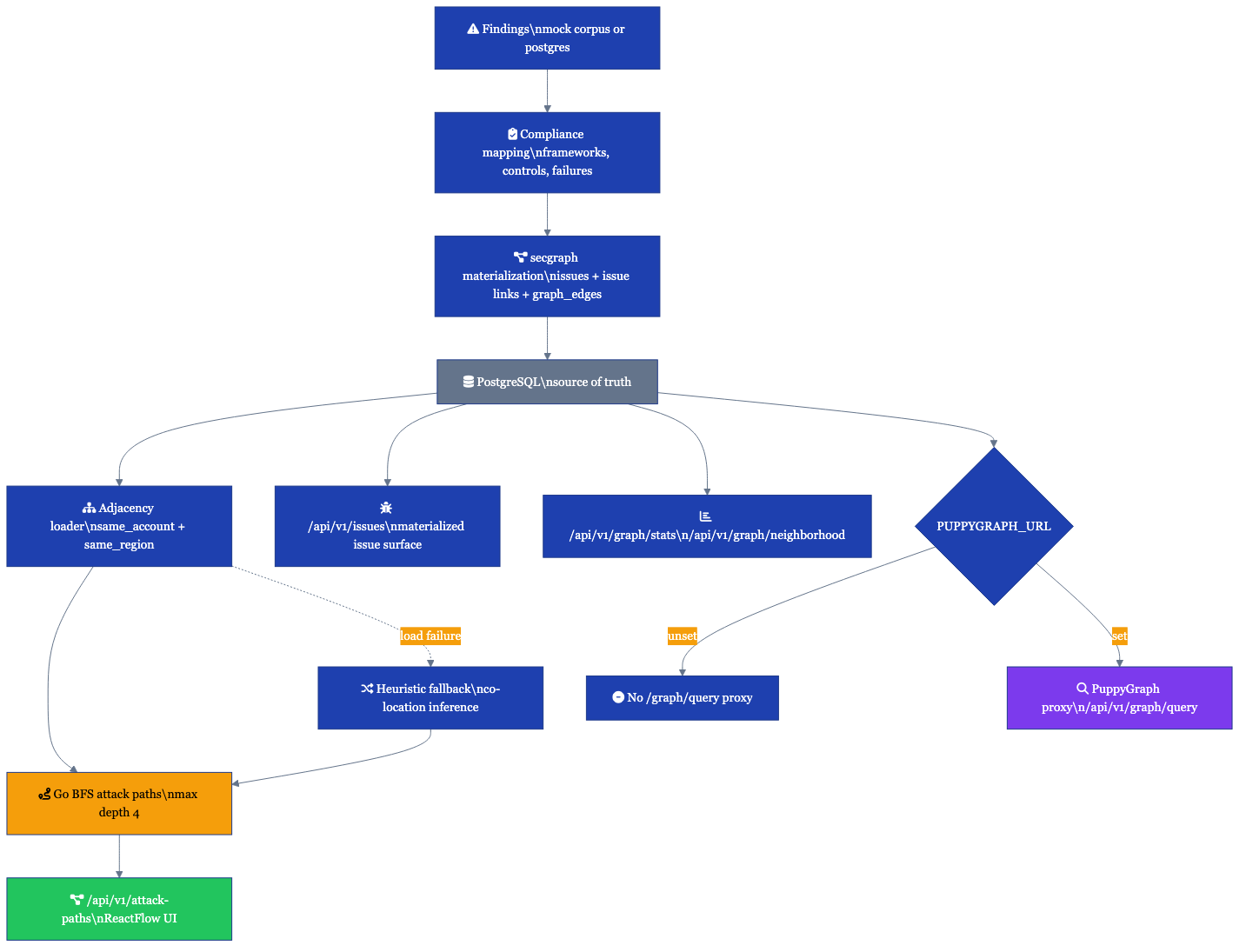
Current-state runtime detail for attack-path computation, secgraph materialization, and the optional PuppyGraph query path:
7.1 Computation Engine
CloudForge computes attack paths with an in-memory BFS engine in the API tier:
- Nodes: Findings projected onto resource-centric attack-path nodes
- Edges: Explicit secgraph resource adjacency from
graph_edgeswhen the database is configured (same_account,same_region); heuristic co-location remains the fallback when adjacency cannot be loaded - Traversal: BFS from entry points (internet-exposed / exploitable) to targets (data stores, secrets, encryption assets)
- Max depth: 4 hops
- Large-corpus mode: deferred/sampled execution is used on constrained Fly runtime profiles to avoid cold-start memory spikes
- Rust acceleration path: the Rust FFI bridge and benchmarks exist, but the active server request path still runs the Go BFS engine today
7.2 Security Graph (secgraph)
The current implementation is backed by the internal/secgraph package and the startup / incremental sync path in cmd/server/secgraph_sync.go. This is the live graph-native issue surface used by the operator APIs today.
- System of record: PostgreSQL stores frameworks, controls, control evaluations, materialized issues, issue-finding links, and explicit
graph_edges - Node taxonomy:
finding,resource,control,issue,account,compliance_framework - Edge taxonomy:
affects,violates,maps_to,evaluated_by,materializes_to,belongs_to,same_account,same_region - Materialization flow: findings are mapped through the compliance engine, converted into control failures, deduplicated into issues by
(control_id, resource_id, tenant_id), then persisted with graph edges - Scoring and routing: blast radius can use secgraph adjacency when available, and issue records can be auto-assigned / auto-ticketed through the existing integration routing layer
- Always-available queries: when
AEGIS_DATABASE_URLis configured, the Postgres CTE querier exposes typed neighborhood and graph stats endpoints without requiring PuppyGraph
See ADR-020 for the full data model and migration plan.
7.3 Graph Query Engine (PuppyGraph)
For richer multi-hop traversal queries beyond the in-process BFS engine (for example, operator-driven graph exploration or investigation queries), CloudForge integrates PuppyGraph Enterprise as an optional zero-ETL graph query layer over PostgreSQL. PuppyGraph supports both Gremlin and openCypher and is exposed through POST /api/v1/graph/query when PUPPYGRAPH_URL is configured. When PuppyGraph is absent or unavailable, the structured Postgres querier and the Go attack-path BFS engine remain the source of truth for current runtime behavior.
See ADR-015 for the graph query layer decision.
7.4 API
| Endpoint | Method | Description |
|---|---|---|
| /api/v1/attack-paths | GET | Paginated attack paths (default 20/page, max 100) |
| /api/v1/attack-paths/{id} | GET | Single path with full finding details |
| /api/v1/attack-paths/stats | GET | Coverage stats (findings in paths vs isolated) |
| /api/v1/issues | GET | Paginated graph-native security issues |
| /api/v1/issues/{id} | GET / PATCH | Issue detail and operator status updates |
| /api/v1/issues/stats | GET | Aggregate issue counts by severity/status |
| /api/v1/graph/neighborhood/{nodeType}/{nodeId} | GET | Typed subgraph within N hops (Postgres CTE querier) |
| /api/v1/graph/stats | GET | Vertex and edge counts grouped by type |
| /api/v1/graph/query | POST | Gremlin / openCypher proxy to PuppyGraph (feature-flagged) |
See ADR-008 for the architecture decision.
8. FinOps Cost Management
8.1 Components
| Component | Package | Description |
|---|---|---|
| Cost Aggregator | internal/finops/aggregator/ | AWS/Azure/GCP cost API clients |
| Anomaly Detection | internal/finops/anomaly/ | ML-based spend anomaly alerting |
| Chargeback Engine | internal/finops/chargeback/ | Tag-based cost allocation + CSV export |
| Budget Monitor | internal/finops/alerting/ | Slack + PagerDuty budget alerts |
| Cost Estimation | internal/finops/estimation.go | 21-resource lookup table |
| Reporter | internal/finops/reporter/ | Showback/chargeback reports |
8.2 Budget Alerting
Budget alerts are sent via two channels:
- Slack: Block Kit formatted messages
- PagerDuty: Events API v2 integration
See ADR-010 for the architecture decision.
9. Deployment Architecture
This section describes the target enterprise / self-managed deployment architecture, not the current public portfolio runtime. The active public demo uses Fly.io for the API tier and Cloudflare Pages for the frontend; the multi-cloud topology below is the forward-state reference model.
9.1 Multi-Cloud Support
9.2 Terraform Modules
| Module | Path | Providers |
|---|---|---|
| Compute | deploy/terraform/modules/compute/ | Cloud Run, ECS Fargate, Azure Container Apps |
| Database | deploy/terraform/modules/database/ | Cloud SQL, RDS, Azure PostgreSQL |
| Redis | deploy/terraform/modules/redis/ | Memorystore, ElastiCache, Azure Cache |
| Network | deploy/terraform/modules/network/ | AWS VPC, Azure VNet, GCP VPC |
| IAM | deploy/terraform/modules/iam/ | GCP SA, AWS IAM Roles, Azure Managed Identity |
| Monitoring | deploy/terraform/modules/monitoring/ | Cloud Monitoring, CloudWatch, Azure Monitor |
| Secrets | deploy/terraform/modules/secrets/ | GCP Secret Manager, AWS Secrets Manager, Azure Key Vault |
| PuppyGraph | deploy/terraform/modules/puppygraph/ | AWS EC2 (POC) |
Environments: dev, staging, prod in deploy/terraform/environments/.
9.3 High Availability (Target State)
- Active-Active across 2+ regions
- Database replication with automatic failover
- State synchronization via distributed consensus
- < 1 minute RTO for compute failures
10. Security Considerations
10.1 Authentication & Authorization
- JWT authentication (HS256/RS256, JWKS caching)
- OIDC federation (Okta, Entra ID) with mock fallback for development
- RBAC middleware (Admin, Operator, Requester roles)
- API rate limiting (Redis-backed, tier-based: anonymous/free/basic/professional/enterprise)
- OIDC/WIF for cloud provider access
10.2 Data Protection
- Encryption at rest (AES-256)
- Encryption in transit (TLS 1.3)
- Secrets in cloud-native vaults (AWS Secrets Manager, Azure Key Vault, GCP Secret Manager)
11. Monitoring & Observability
11.1 Telemetry Stack
| Component | Tool | Purpose |
|---|---|---|
| Metrics | Prometheus + Grafana | System and application metrics |
| Logging | Structured JSON (zap) to ELK/Splunk | Centralized log aggregation |
| Tracing | OpenTelemetry | Distributed tracing across services |
| Alerting | PagerDuty/Opsgenie | Incident notification |
11.2 Key Metrics
| Metric | Description | Alert Threshold |
|---|---|---|
aegis_http_requests_total | Total HTTP requests by method/path/status | - |
aegis_http_request_duration_seconds | Request latency histogram | P99 > 500ms |
aegis_findings_processed_total | Findings processed by source/type/severity | - |
aegis_ai_analysis_duration_seconds | AI analysis duration | P99 > 30s |
aegis_health_status | Component health (1=healthy, 0=unhealthy) | Any 0 |
aegis_rate_limit_hits_total | Rate limit violations | >100/min |
11.3 Health Endpoints
| Endpoint | Purpose | Response |
|---|---|---|
/health | Detailed health check | All components with latency |
/healthz | Kubernetes liveness probe | {"status": "alive"} |
/ready | Kubernetes readiness probe | Full component health status |
/metrics | Prometheus metrics | Prometheus format |
11.4 Troubleshooting
Built-in troubleshooting capabilities provide remediation suggestions for common issues:
- Database connection failures: Connection pooling, credential verification
- Redis connection issues: Endpoint verification, memory analysis
- AI provider timeouts: Fallback provider activation, rate limit handling
- High memory/CPU usage: Profiling endpoints at
/debug/pprof/
See Technical Runbooks for detailed operational procedures.
12. API Reference
12.1 Core Endpoints
| Endpoint | Method | RBAC | Description |
|---|---|---|---|
| /api/v1/findings | GET | operator, admin | List findings |
| /api/v1/findings/{id} | GET | operator, admin | Get finding detail |
| /api/v1/findings/{id}/enrich | POST | operator, admin | Enrich finding with AI |
| /api/v1/compliance/frameworks | GET | operator, admin | List available frameworks |
| /api/v1/attack-paths | GET | operator, admin | List attack paths (paginated) |
| /api/v1/attack-paths/stats | GET | operator, admin | Attack path coverage stats |
| /api/v1/attack-paths/{id} | GET | operator, admin | Get attack path detail |
| /api/v1/remediations | GET | operator, admin | List remediations |
| /api/v1/remediations/{id} | GET | operator, admin | Get remediation detail |
| /api/v1/remediations/{id}/execute | POST | admin | Execute remediation |
| /api/v1/costs/summary | GET | operator, admin | Get cost summary |
| /api/v1/exceptions | POST | admin | Create exception |
| /api/v1/exceptions/{id} | GET | operator, admin | Get exception |
| /api/v1/exceptions/mine | GET | requester+ | Get my exceptions |
| /api/v1/exceptions/pending | GET | operator, admin | Pending approvals |
| /api/v1/exceptions/expiring | GET | operator, admin | Expiring exceptions |
| /api/v1/exceptions/{id}/approve | POST | admin | Submit approval |
| /api/v1/validate/exception | POST | operator, admin | Validate exception against policy |
| /api/v1/agents | GET | operator, admin | List AI agents |
| /api/v1/agents/{id} | GET | operator, admin | Get agent detail |
| /api/v1/agents/{id}/traces | GET | operator, admin | Get agent traces |
| /api/v1/audit-log | GET | admin | List audit log |
| /api/v1/users | GET | admin | List users |
| /api/v1/catalog/modules | GET | operator, admin | List catalog modules |
| /api/v1/policies | GET | operator, admin | List policies |
| /api/v1/workflows | GET | operator, admin | List workflows |
| /api/v1/workflows/{id} | GET | operator, admin | Get workflow |
| /api/v1/workflows/{id}/approve | POST | admin | Approve workflow |
| /api/v1/container/scan | GET | operator, admin | Scan container |
| /api/v1/container/admission | GET | operator, admin | Check admission |
| /api/v1/secrets | GET | operator, admin | List secrets |
| /api/v1/secrets/scan | POST | operator, admin | Scan for secrets (content in request body) |
| /api/v1/secrets/{path} | GET | operator, admin | Get secret |
| /api/v1/waf/templates | GET | operator, admin | List WAF templates |
| /api/v1/waf/compliance/{templateId} | GET | operator, admin | Validate WAF compliance |
| /api/v1/identity/users | GET | operator, admin | List identity users |
| /api/v1/identity/users/{id}/risk | GET | operator, admin | Get user risk score |
| /api/v1/ai/nlq | POST | operator, admin | Natural language query |
| /api/v1/containers | GET | operator, admin | Container security topology |
| /api/v1/ai/usage | GET | admin | AI budget status (monthly spend vs cap) |
13. Data Ingestion Pipeline
13.1 Architecture
The ingestion subsystem normalizes findings from multiple cloud security scanners into a canonical format and deduplicates them before persistence.
13.2 Scanner Adapters
Each scanner implements the ScannerAdapter interface (Parse(ctx, data) → []NormalizedFinding):
| Adapter | Source | Severity Resolution |
|---|---|---|
| ProwlerAdapter | Prowler JSON | Vendor severity via normalizeSeverity() |
| TrivyAdapter | Trivy JSON | Vendor severity via normalizeSeverity() |
| AWSConfigAdapter | AWS Config rules | Heuristic (rule name keywords: "root-account"/"mfa" → CRITICAL) |
Severity is canonicalized to CRITICAL/HIGH/MEDIUM/LOW. INFORMATIONAL findings are intentionally dropped.
13.3 Deduplication
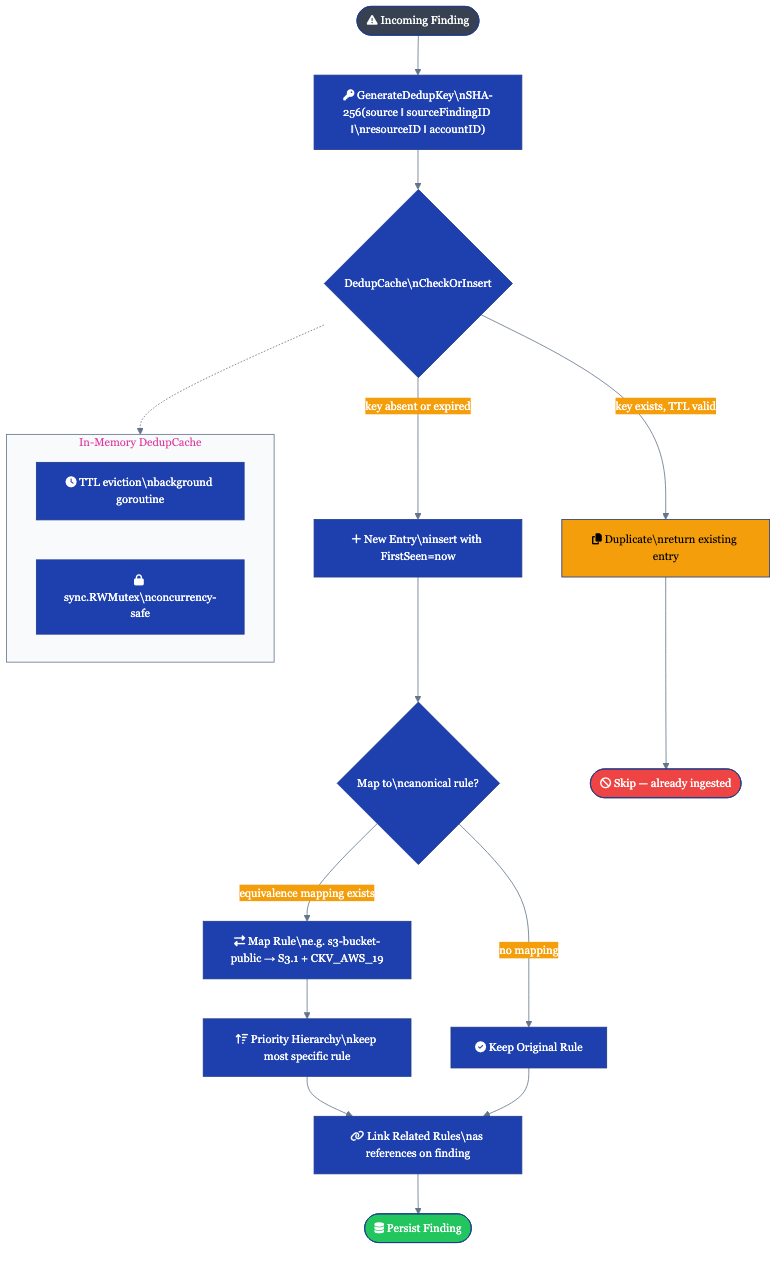
In-memory SHA-256 keyed cache with TTL-based eviction:
- Key: SHA-256 of
source \x00 sourceFindingID \x00 resourceID \x00 accountID(null-byte delimiters prevent field-split collisions) - Atomic check-and-insert:
CheckOrInsert()acquires a write lock and returns both duplicate status and existing entry - Background eviction: goroutine on configurable interval, cancelled via context
14. Ticket Integration System
14.1 Provider Architecture
Remediation workflows route findings to external ticket/project management systems via the TicketProvider interface:
| Provider | Auth | Description Format | ID Validation |
|---|---|---|---|
| Jira | Basic (API token) | Atlassian Document Format (ADF) | ^[A-Z][A-Z0-9_]+-\d+$ |
| Asana | Bearer (PAT) | Plain text | ^\d+$ |
| Azure DevOps | PAT | HTML (escaped) | ^\d+$ |
| Mock | None | In-memory | Any |
All REST clients implement exponential backoff with max 3 retries on 429/5xx responses. Configuration loaded from environment variables via ConfigFromEnv().
14.2 Risk-Aware Routing
The RoutingEngine maps finding severity and attack graph signals to ticket priority and SLA:
| Input Condition | Priority | Team | SLA |
|---|---|---|---|
| CRITICAL + choke-point | Urgent | incident-response | 4 hours |
| CRITICAL | Urgent | security-ops | 24 hours |
| HIGH | High | security-ops | 72 hours |
| MEDIUM | Normal | platform-eng | 7 days |
| LOW (fallback) | Low | backlog | 30 days |
Routing rules are first-match-wins with a configurable rule set (RoutingRule with match function + decision).
15. Webhook Delivery System
15.1 Architecture
Outbound webhook engine delivers CloudForge events to registered HTTP endpoints with HMAC-SHA256 signing.
15.2 Event Types
| Event Type | Trigger |
|---|---|
finding.created | New finding ingested |
finding.resolved | Finding marked resolved |
compliance.drift | Compliance posture change |
attack_path.new | New attack path discovered |
exception.approved | Exception request approved |
deploy.preview | Deploy preview ready |
Endpoints subscribe to specific event types or receive all events (empty filter = all).
15.3 Security
- HMAC signing:
X-Aegis-Signatureheader with SHA-256 HMAC when endpoint has a secret - SSRF protection (2-layer): (1) URL validation at registration rejects non-HTTPS, private IPs, localhost, metadata endpoints; (2)
safeDialContext()rejects private/link-local IPs after DNS resolution (DNS rebinding defense) - SA-106: HTTPS-only enforcement for webhook URLs
15.4 Delivery
Asynchronous fan-out: DeliverAsync() spawns goroutines per matching endpoint. Each delivery attempt is tracked with HTTP status code and duration. HTTP client timeout: 10 seconds.
16. Integrated Operations Terminal
16.1 Architecture
WebSocket-based interactive terminal for running read-only cloud CLI commands from the browser UI.
16.2 Security Controls
| Control | Implementation |
|---|---|
| Authentication | Two-phase ticket system (SA-002): JWT → 60s nonce → WS upgrade |
| Authorization | RBAC: operator or admin only |
| Command whitelist | Read-only cloud CLI subcommands only (aws, gcloud, az, kubectl, terraform, trivy) |
| Shell injection | Metacharacter rejection (|;&$\><(){}!#\n\r`) before parsing |
| Dangerous flags | Blocks --endpoint-url, --profile, --impersonate-service-account |
| Environment | safeEnv() strips all env vars except PATH, HOME=/tmp, TERM |
| Limits | 30s timeout, 512KB output, 4KB message, 2 sessions/user, 5min idle |
| Audit | All connect/execute/denied events logged via audit.AuditLogger |
| Mock fallback | Returns realistic demo output when binary not on PATH |
17. Resource Query Language (RQL)
17.1 Grammar
Hand-written lexer and recursive-descent parser for filtering findings and resources:
query      = condition { ("AND" | "OR") condition }
condition  = field operator value
field      = identifier { "." identifier }
operator   = "=" | "!=" | ">" | ">=" | "<" | "<="
value      = quoted_string | unquoted_word
17.2 Evaluation
- Field access: Decoupled via
FieldAccessorfunction (dependency injection) - Precedence: Left-to-right, AND binds tighter than OR. No parenthesized grouping.
- String comparison: Case-insensitive for
=and!= - Numeric comparison: Via
strconv.ParseFloatfor>,>=,<,<= - Ordered fields: Inverted comparison for severity-like fields (CRITICAL=1 < HIGH=2), so
severity >= HIGHmatches CRITICAL and HIGH
18. Attack Surface Management
18.1 Architecture
External-facing asset discovery that scans domains for hosts, services, ports, and TLS certificates via the ASMScanner interface.
18.2 Asset Model
| Component | Fields |
|---|---|
| Asset | Hostname, IP, Services, Certificates, FirstSeen, LastSeen |
| ExposedService | Port, Protocol (HTTP/HTTPS/SSH/DNS/SMTP/FTP), Banner, TLS flag |
| Certificate | Subject, Issuer, NotBefore, NotAfter, SANs |
Current implementation provides a deterministic mock scanner (SHA-256 domain seed for reproducible demo data). Real scanner implementations plug in behind the same ASMScanner interface.
19. Multi-Tenancy
19.1 Tenant Resolution
Request-scoped tenant resolution via middleware with a 3-level cascade:
| Priority | Source | Restriction |
|---|---|---|
| 1 (highest) | JWT tenant_id claim | Any authenticated user |
| 2 | X-Tenant-ID header | Admin role only |
| 3 | Subdomain extraction from Host header | Any request |
When no tenant is resolved, defaults to ("default", "") for single-tenant backward compatibility. nil store disables multi-tenancy (middleware becomes a no-op).
19.2 Tenant Configuration
Per-tenant configuration includes:
| Area | Config |
|---|---|
| Branding | CompanyName, ProductName, LogoPath, PrimaryColor, AccentColor |
| Auth | OIDC provider (okta/entra_id/auth0/mock), Issuer, ClientID, Audience |
| Modules | Enabled feature modules |
| Rate Limits | RequestsPerMinute, BurstSize |
In-memory store (Phase 3 prototype). Postgres-backed store planned for Phase 4.
20. AI Governance
20.1 Architecture
Agent governance framework with in-process embedded OPA policy engine (microsecond-level evaluation, not HTTP sidecar). Provides agent registry, observability tracing, threat modeling (STRIDE + MITRE ATLAS), and maturity assessment.
20.2 Policy Engine
Two base policies embedded as Go constants:
| Policy | Controls |
|---|---|
| BaseToolAccessPolicy | Tool allowlist/blocklist, rate limiting, forbidden parameter patterns |
| BaseDataFlowPolicy | Classification-based destination control, source restrictions, PII redaction |
Policies are compiled at load time via rego.PreparedEvalQuery for sub-millisecond evaluation. Returns structured Decision with Allow, Reasons, Violations, and EvalTimeUs.
20.3 Observability Model
| Component | Purpose |
|---|---|
| AgentTrace | Full execution trace per agent invocation |
| Span | Individual operation (types: llm, retrieval, tool, chain, agent, policy) |
| SecuritySignal | Injection attempts, data exfiltration, tool abuse, privilege escalation |
| TraceMetrics | Aggregated performance and cost metrics |
LLM spans track token counts and cost. Retrieval spans track vector similarity scores. Tool spans include inline policy decisions.
21. Audit System
21.1 Architecture
Tamper-evident, append-only audit logging with SHA-256 integrity hashes and multiple backend support.
21.2 Event Taxonomy
Domain.Verb format across 12 domains:
| Domain | Example Actions |
|---|---|
| exception | create, approve, reject, expire, revoke |
| finding | create, update, remediate, suppress |
| remediation | execute, rollback |
| terminal | connect, execute, denied |
| agent | invoke, complete, fail |
| deploy_preview | create, promote |
| user | login, logout, role_change |
| secret | rotate, access, scan |
21.3 Integrity
computeHash() produces SHA-256 of all content fields with null-byte delimiters. Stored as IntegrityHash on every AuditEntry. Postgres backend includes automatic tenant_id scoping via tenant.IDFromContext().
22. GRC Integration
22.1 Provider Architecture
Policy exception lifecycle management via the GRCProvider interface (8 methods). Factory pattern (NewProvider(Config)) creates the appropriate backend:
| Provider | Backend | Status |
|---|---|---|
| Memory | In-memory map | Demo/test |
| Postgres | PostgreSQL | Self-hosted production |
| ServiceNow | ServiceNow GRC REST API | Enterprise |
| Archer | RSA Archer REST API | Stub (documented) |
22.2 Exception Lifecycle
Approval chain: multi-level (SECURITY_LEAD → GRC_ANALYST → CISO). Empty approval chain does NOT auto-approve. ValidateException() is the integration point with the policy engine — called before provisioning.
22.3 Security
- Credentials loaded from environment variables at init (never stored in config structs)
- ServiceNow query injection prevention:
snowSafeInputregex^[a-zA-Z0-9._@\-]+$+ URL encoding - ServiceNow OAuth token caching with double-check locking pattern
- All HTTP response bodies limited to 1MB via
io.LimitReader - Postgres queries use parameterized placeholders (
$N) andpq.Array()for batch operations - All Postgres queries include
tenant_idscoping
See ADR-007 for the architecture decision.
Appendix A: Technology Stack
| Category | Technology |
|---|---|
| Language | Go 1.25 |
| API Framework | gorilla/mux |
| Frontend | React 19 / Vite 7 / Tailwind CSS v4 / shadcn/ui |
| Database | PostgreSQL 16 |
| Cache | Redis |
| Orchestration | Temporal |
| Policy Engine | OPA / Rego |
| AI | Anthropic Claude Opus 4.6, OpenAI GPT-4, AWS Bedrock (production enrichment) |
| IaC | Terraform |
| Container Runtime | Kubernetes (EKS/AKS/GKE) |
| Observability | OpenTelemetry, Prometheus, zap |
| Identity | Okta, Microsoft Entra ID (OIDC) |
| Deployment | Cloudflare Pages (frontend), Fly.io (backend) |
Appendix B: Diagram Formats
Note on LucidChart Import: Mermaid diagrams are rendered as static images when imported to LucidChart. For editable diagrams:
- Recommended: Create directly in LucidChart or use draw.io
- Export: Use draw.io XML format for cross-platform compatibility
- Alternative: Use PlantUML with LucidChart import extension
Architecture diagrams in this document use Mermaid for GitHub rendering and can be recreated in LucidChart for presentation purposes.
Document History
| Version | Date | Author | Changes |
|---|---|---|---|
| 4.0 | March 2026 | L. Vo-Nguyen | Expanded from 12 to 22 sections: added Data Ingestion (13), Ticket Integration (14), Webhooks (15), Terminal (16), RQL (17), ASM (18), Multi-Tenancy (19), AI Governance (20), Audit (21), GRC (22) |
| 3.1 | March 2026 | L. Vo-Nguyen | Added Viewer role to RBAC table, updated ADR count (009-014), added POST /api/v1/ai/nlq + GET /api/v1/containers + GET /api/v1/ai/usage to API reference, changed /secrets/scan from GET to POST |
| 3.0 | March 2026 | L. Vo-Nguyen | Updated tech stack (Go 1.25, gorilla/mux, React 19), added remediation/attack path/FinOps/CSPM sections, full API reference from routes.go, corrected RBAC model, added ADR cross-references |
| 2.0 | January 2026 | L. Vo-Nguyen | Architecture overview, compliance engine, CI/CD, identity, deployment |
| 1.0 | January 2026 | L. Vo-Nguyen | Initial HLD |