CloudForge - Disaster Recovery & Business Continuity
Version: 2.1 Author: Liem Vo-Nguyen Last Updated: March 20, 2026
Executive Summary
This document outlines the DR/BC strategy for CloudForge, an enterprise cloud governance platform, across AWS, Azure, and GCP deployments. Version 2.0 expands coverage to include global deployment architecture, compliance-driven deployment models (GDPR, PCI-DSS, HIPAA, SOX, FedRAMP), enhanced SLA targets with alerting thresholds, component-level restore procedures, data retention and archival policies, and a cross-cloud failover matrix.
CloudForge manages cloud security posture, policy enforcement, and AI-driven remediation for enterprise customers. Availability and data integrity are non-negotiable: a failure in CloudForge means undetected misconfigurations in customer environments.
Recovery Objectives
| Metric | Target | Description |
|---|---|---|
| RTO | 2 hours | Maximum acceptable downtime (automated: 30 min) |
| RPO | 5 minutes | Maximum acceptable data loss |
| MTTR | 1 hour | Average time to restore service |
| MTBF | 720 hours | Minimum mean time between failures |
Service Criticality
| Component | Criticality | RTO | RPO | Notes |
|---|---|---|---|---|
| Policy Engine (OPA) | Critical | 30 min | N/A | Stateless; bundle restored from Git |
| GRC Integration | High | 1 hour | 5 min | State in external GRC system |
| Template Engine | Critical | 30 min | N/A | Templates versioned in Git |
| API Gateway | Critical | 15 min | N/A | Stateless; redeploy from image |
| Request Workflow | High | 1 hour | 5 min | State in PostgreSQL |
| Temporal Orchestration | High | 1 hour | 5 min | Temporal cluster + Cassandra |
| PostgreSQL | Critical | 30 min | 5 min | Primary data store |
| Redis Cache | Medium | 15 min | N/A | Stateless; warms on traffic |
| AI Provider Proxy | High | 1 hour | N/A | Failover to secondary provider |
| Secrets (KMS/Vault) | Critical | 30 min | N/A | Hardware-backed; cross-region replica |
Global Deployment Architecture
Deployment Strategy by Region Tier
Tier 1 — Primary Production (Active)
  |-- Serves all live traffic
  |-- Full stack: API, OPA, Temporal, PostgreSQL, Redis
  |-- 3+ availability zones
  |-- 99.9% SLA commitment

Tier 2 — DR Region (Warm Standby)
  |-- Database replica in sync (RPO: 5 min)
  |-- K8s cluster pre-provisioned, pods at 0 replicas
  |-- Scale-up time: < 10 minutes
  |-- Activated on Tier 1 failure

Tier 3 — Edge (Policy Evaluation Only)
  |-- Read-only OPA bundle replicated
  |-- Latency < 50ms for policy decisions in region
  |-- No writes; stateless
Active-Active vs Active-Passive Decision Matrix
| Customer Requirement | Architecture | Primary/DR Pair | Rationale |
|---|---|---|---|
| < 5ms regional failover | Active-Active | Dual primary | Zero-downtime; double cost |
| Data sovereignty (EU) | Active-Passive | eu-west-1 / eu-central-1 | GDPR compliance |
| Cost-optimized | Active-Passive | Primary + cold standby | 60% cost reduction |
| Government / FedRAMP | GovCloud only | us-gov-west-1 / us-gov-east-1 | Regulatory boundary |
| Global enterprise | Active-Active per continent | 3x primary (US/EU/APAC) | Latency + sovereignty |
Global Load Balancing
[Client Request]
       |
       v
+------+---------------------------------------+
|  Global Traffic Management Layer             |
|  AWS: Route 53 Latency Routing               |
|  Azure: Traffic Manager (Performance)        |
|  GCP: Cloud DNS + Global Load Balancer       |
|                                              |
|  Health probe: GET /health (every 10s)       |
|  Failover threshold: 3 consecutive failures  |
+------+---------------------------------------+
       |
  +----+----+
  |         |
  v         v
AWS        Azure / GCP
Primary    Primary
Failover TTL Strategy:
- Health check interval: 10 seconds
- Failure threshold: 3 consecutive failures
- DNS TTL: 30 seconds (low to enable fast cutover)
- Propagation estimate: 60-90 seconds globally
Cross-Region Database Replication per CSP
| CSP | Primary | DR Region | Replication Method | Lag Target | Failover Method |
|---|---|---|---|---|---|
| AWS | us-west-2 | us-east-1 | RDS Multi-AZ + Read Replica | < 5s | RDS Promoted Replica |
| Azure | westus2 | eastus | Azure SQL Failover Group | < 5s | Auto-failover group |
| GCP | us-west1 | us-east1 | Cloud SQL HA + Regional Replica | < 5s | Cloud SQL promotion |
| AWS EU | eu-west-1 | eu-central-1 | RDS Cross-Region Replica | < 10s | Manual promotion |
Cross-CSP Replication (Active-Active customers):
- PostgreSQL logical replication via pg_logical (async, eventual consistency)
- Conflict resolution: last-write-wins with vector clocks per tenant
- Replication lag monitored via
pg_stat_replication; alert at > 30s
CDN Strategy for Portal UI
| CSP Deployment | CDN Solution | Cache TTL | Origin Shield |
|---|---|---|---|
| AWS | CloudFront | Static: 1yr / API: 0 | Regional Edge Cache |
| Azure | Azure Front Door | Static: 1yr / API: 0 | Edge PoP closest to origin |
| GCP | Cloud CDN | Static: 1yr / API: 0 | Cloud CDN origin shield |
Cache Invalidation on Deploy:
# AWS
aws cloudfront create-invalidation --distribution-id $CF_ID --paths "/*"

# Azure
az afd endpoint purge --resource-group $RG --profile-name $AFD --endpoint-name $EP \
  --domains "*" --content-paths "/*"

# GCP
gcloud compute url-maps invalidate-cdn-cache $URL_MAP --path "/*"
Edge Policy Evaluation (Low-Latency OPA)
OPA policy bundles are replicated to edge nodes for sub-50ms policy decisions without a round trip to the primary region.
Git Repository (Policy Source of Truth)
         |
         | git push (CI/CD)
         v
  OPA Bundle Builder
  (signed bundle: .tar.gz + .sig)
         |
         +-- AWS S3 (us-west-2)
         |       |-- replicates to us-east-1, eu-west-1
         +-- Azure Blob (westus2)
         |       |-- geo-replicates to eastus, westeurope
         +-- GCP GCS (us-west1)
                 |-- dual-region: us (nam4), europe-west (eur4)

Edge OPA Sidecar:
  - Polls bundle endpoint every 60s
  - Verifies bundle signature (Ed25519)
  - In-memory decision cache: 30s TTL
  - Decision log shipped async to central Kafka
Multi-Cloud DR Architecture
AWS Deployment
AWS Primary (us-west-2)
├── EKS Cluster (3 nodes, 3 AZ)
│   ├── aegis-api (3 replicas)
│   ├── aegis-opa (2 replicas)
│   ├── temporal-server (2 replicas)
│   └── aegis-worker (2 replicas)
├── RDS PostgreSQL (Multi-AZ, r6g.large)
├── ElastiCache Redis (cluster mode)
├── S3 (versioned, cross-region replication ON)
└── Secrets Manager (cross-region replication)

        Cross-Region Replication (async, < 5s lag)
                        │
                        ▼
AWS DR (us-east-1)
├── EKS Cluster (3 nodes, pre-provisioned, 0 pods)
├── RDS Read Replica (promote on failover)
├── ElastiCache (cold standby)
└── S3 Replica (read-only until failover)
Azure Deployment
Azure Primary (West US 2)
├── AKS Cluster (3 nodes, 3 AZ)
│   ├── aegis-api (3 replicas)
│   ├── aegis-opa (2 replicas)
│   ├── temporal-server (2 replicas)
│   └── aegis-worker (2 replicas)
├── Azure SQL (Geo-Replicated, Business Critical)
├── Azure Cache for Redis (zone-redundant)
├── Blob Storage (GRS — geo-redundant)
└── Key Vault (geo-replicated)

        Geo-Replication (auto-failover group)
                │
                ▼
Azure DR (East US)
├── AKS Cluster (3 nodes, 0 pods)
├── SQL Failover Group (secondary, readable)
├── Redis (cold standby)
└── Blob GRS Secondary (read-only endpoint)
GCP Deployment
GCP Primary (us-west1)
├── GKE Cluster (3 nodes, multi-zone)
│   ├── aegis-api (3 replicas)
│   ├── aegis-opa (2 replicas)
│   ├── temporal-server (2 replicas)
│   └── aegis-worker (2 replicas)
├── Cloud SQL (Regional HA, postgres 15)
├── Memorystore Redis (HA)
├── GCS (dual-region: NAM4)
└── Secret Manager (global with replication policy)

        Regional Replication
                │
                ▼
GCP DR (us-east1)
├── GKE Cluster (3 nodes, 0 pods)
├── Cloud SQL Regional Replica
├── Memorystore (cold standby)
└── GCS Dual-region (both regions readable)
Multi-Cloud Failover Matrix
Cross-Cloud Failover Paths
| Source Cloud | Target Cloud | Data Sync Mechanism | DNS Migration | Est. Switchover |
|---|---|---|---|---|
| AWS | Azure | pg_logical replication + S3 → Blob sync | Route 53 CNAME → Traffic Manager | 45-90 min |
| Azure | GCP | pg_logical replication + Blob → GCS sync | Traffic Manager → Cloud DNS | 45-90 min |
| GCP | AWS | pg_logical replication + GCS → S3 sync | Cloud DNS → Route 53 | 45-90 min |
| AWS | GCP | pg_logical replication + S3 → GCS sync | Route 53 CNAME → Cloud DNS | 45-90 min |
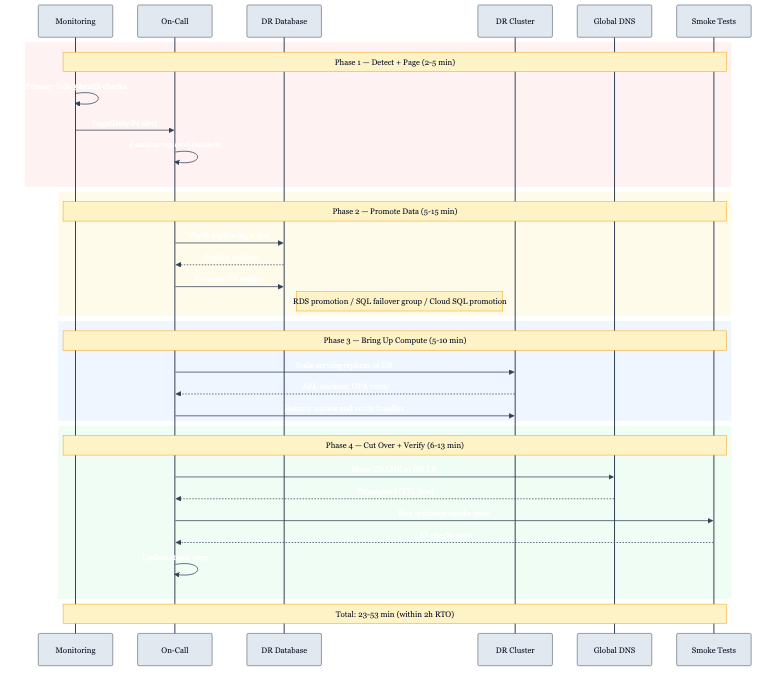
Cross-Cloud Failover: AWS → Azure
Step 1: Verify Azure DR database lag < 60s
        (monitor via aegis_replication_lag_seconds metric)

Step 2: Scale up AKS cluster in Azure DR region
        kubectl scale deploy --replicas=3 -n aegis (all deployments)

Step 3: Promote Azure SQL secondary to primary
        az sql failover-group set-primary --name aegis-fg \
          --resource-group $RG --server $AZURE_DR_SERVER

Step 4: Restore OPA bundle from Azure Blob
        (bundle already replicated; OPA sidecars pick up on next poll)

Step 5: Update Azure Key Vault secrets from export
        (pre-staged encrypted export in Blob Storage)

Step 6: Migrate DNS — Route 53 CNAME → Azure Traffic Manager FQDN
        TTL switch: 30s record TTL set 24h prior to any planned failover

Step 7: Smoke test via synthetic monitor (Checkly / CloudWatch Synthetics)

Step 8: Notify customers via status page (status.aegis.io)
Data Sync Mechanisms:
- PostgreSQL: pg_logical extension; replication slot on primary writes WAL to target
- Object storage: rclone sync job (runs every 5 min); bidirectional diff only
- Secrets: cross-cloud secret export encrypted with per-customer BYOK key
- Kubernetes state: Velero backup restored from cloud-neutral object store (S3 or Blob or GCS)
Cross-Cloud Failover: Azure → GCP
Step 1: Verify GCP Cloud SQL replica lag < 60s
Step 2: Scale GKE cluster to target replica counts
Step 3: Promote Cloud SQL replica: gcloud sql instances promote-replica aegis-dr
Step 4: Sync Blob → GCS via rclone (delta sync)
Step 5: Restore secrets to GCP Secret Manager
Step 6: Update DNS: Traffic Manager profile → Cloud DNS managed zone
Step 7: Smoke test and notify
Cross-Cloud Failover: GCP → AWS
Step 1: Verify RDS replica lag < 60s
Step 2: Scale EKS node group to 3 nodes; deploy pods
Step 3: Promote RDS Read Replica: aws rds promote-read-replica
Step 4: Sync GCS → S3 via rclone (delta sync)
Step 5: Restore secrets to AWS Secrets Manager
Step 6: Update DNS: Cloud DNS → Route 53
Step 7: Smoke test and notify
Estimated Switchover Times by Phase:
| Phase | Duration | Activity |
|---|---|---|
| Detection + alert | 2-5 min | Health check failures trigger PagerDuty |
| Decision + auth | 5-10 min | On-call confirms, runbook initiated |
| Database promotion | 5-15 min | Replica lag drain + promotion |
| K8s scale-up | 5-10 min | Pods running and passing readiness |
| DNS propagation | 1-3 min | Low-TTL records propagate |
| Smoke test | 5-10 min | Synthetic checks pass |
| Total | 23-53 min | Within 2-hour RTO |
Compliance-Driven Deployment Models
GDPR (EU/EEA)
Scope: Any CloudForge tenant processing findings that contain or reference personal data of EU/EEA residents.
Data Residency Requirements:
| Data Type | Must Stay In | Storage | Transfer Allowed? |
|---|---|---|---|
| Findings with EU PII | EU region | eu-west-1, eu-central-1 | No — SCCs required |
| Audit logs | EU region | Same as above | No |
| Customer credentials | EU region | EU KMS | No |
| Anonymized telemetry | Any | Global | Yes |
| OPA policy bundles | Any (no PII) | Global CDN | Yes |
Recommended Region Pairs:
| CSP | Primary | DR |
|---|---|---|
| AWS | eu-west-1 (Ireland) | eu-central-1 (Frankfurt) |
| Azure | westeurope (Netherlands) | germanywestcentral |
| GCP | europe-west1 (Belgium) | europe-west3 (Frankfurt) |
Right to Erasure (Article 17) Pipeline:
Customer DPO submits erasure request
          |
          v
CloudForge Admin API: DELETE /api/v1/tenants/{id}/subjects/{subject_id}
          |
          +-- Mark findings as "erasure_pending" in PostgreSQL
          +-- Queue erasure job in Temporal workflow
          |
          v
Temporal: EraseSubjectWorkflow
  1. Soft-delete all findings referencing subject_id
  2. Purge from Redis cache (SCAN + DEL)
  3. Write immutable audit record: who requested, what was erased, when
  4. Trigger S3/Blob/GCS object version deletion for exported reports
  5. Emit erasure completion event to GRC system
          |
          v
Audit trail retained (pseudonymized: "data erased per Art.17 request #XYZ")
Retention: 7 years (legal obligation to prove erasure occurred)
AI Provider Implications (Claude API / Anthropic):
- CloudForge sends finding metadata to Claude API for AI analysis
- GDPR Article 28 requires a Data Processing Agreement (DPA) with Anthropic
- EU customers: configure
ai.provider.endpointto Anthropic EU endpoint when available; otherwise SCC applies - Finding payloads sent to AI: strip PII before transmission (regex + NLP PII scrubber in
internal/ai/sanitizer.go) - Data sent to AI is never stored by CloudForge; Anthropic zero-data-retention policy applies
Cross-Border Transfer Mechanisms:
| Scenario | Mechanism | Status |
|---|---|---|
| EU → US (Claude API) | Standard Contractual Clauses (SCCs) | Required |
| EU → US (monitoring) | SCCs + adequacy assessment | Required |
| UK → EU | UK IDTA addendum to SCCs | Required post-Brexit |
| Switzerland → EU | Swiss nFADP + SCCs | Required |
DPO Contact Integration:
dpo_contactfield in tenant configuration (stored intenantstable)- Erasure request notifications auto-sent to DPO email on completion
- Annual DPIA review reminder scheduled via Temporal cron workflow
PCI-DSS (Banking / Financial Services)
Scope: Tenants where CloudForge scans environments that host, process, or transmit cardholder data (Cardholder Data Environment — CDE).
Critical Note: CloudForge does NOT store payment card data. However, findings may reference CDE resources (EC2 instances, network segments, S3 buckets in-scope for PCI). These findings are treated as PCI-sensitive.
Network Segmentation:
+----------------------------+     +---------------------------+
|  CloudForge Control Plane  |     |  Customer CDE             |
|  (PCI-adjacent, not CDE)   |     |  (PCI scope)              |
|                            |     |                           |
|  API Gateway               |     |  CloudForge Agent         |
|  OPA Policy Engine         |<--->|  (read-only scanner)      |
|  AI Analysis               |     |  Findings pushed via TLS  |
|  Remediation Executor      |     |                           |
+----------------------------+     +---------------------------+
         |
         | Findings stored (no raw PAN data)
         v
   PostgreSQL (PCI-adjacent schema)
   Encryption: AES-256-GCM at rest
   TLS 1.2+ in transit (TLS 1.3 preferred)
Encryption Requirements:
| Layer | Requirement | Implementation |
|---|---|---|
| Data in transit | TLS 1.2 minimum (TLS 1.3 preferred) | NGINX/Envoy TLS policy |
| Data at rest (DB) | AES-256 | RDS/Azure SQL/Cloud SQL transparent encryption |
| Data at rest (Object) | AES-256 | S3 SSE-KMS / Azure SSE / GCS CMEK |
| Backup encryption | AES-256 | KMS-encrypted snapshots |
| Key management | HSM-backed KMS | AWS CloudHSM / Azure Dedicated HSM / Cloud HSM |
| BYOK | Customer-managed keys | KMS key import or BYOK |
Key Management:
- Key rotation: automatic, every 365 days (configurable to 90 days for PCI)
- Key hierarchy: Master Key (HSM) → Data Encryption Key (KMS) → Per-record key
- Key deletion: 7-day waiting period minimum; requires dual-person authorization
Access Logging (Tamper-Evident Audit Trail):
- All API requests logged to append-only log store (S3 with Object Lock / Azure Immutable Blob / GCS WORM)
- Log fields: timestamp, user_id, tenant_id, action, resource, source_ip, result
- Log integrity: SHA-256 hash chain; each log entry references previous entry hash
- Log retention: 1 year immediately accessible, 3 years archived (PCI Req 10.7)
- Log export: CloudWatch Logs Insights / Azure Monitor / Cloud Logging
Vulnerability Management SLAs (PCI Req 6.3.3):
| Severity | Max Time to Remediate | CloudForge Finding Priority | Alert Channel |
|---|---|---|---|
| Critical (CVSS 9.0-10.0) | 1 day | P1 | PagerDuty (immediate) |
| High (CVSS 7.0-8.9) | 7 days | P2 | PagerDuty (business hours) |
| Medium (CVSS 4.0-6.9) | 30 days | P3 | Jira ticket |
| Low (CVSS 0.1-3.9) | 90 days | P4 | Weekly digest |
Segregation of Duties in Deployment Pipeline:
| Role | Can Deploy to Staging | Can Deploy to Prod | Can Approve Prod |
|---|---|---|---|
| Developer | Yes | No | No |
| Senior Engineer | Yes | No | Yes (1 of 2) |
| Release Manager | Yes | No | Yes (2 of 2) |
| CI/CD Service Account | Yes | Yes (requires 2 approvals) | No |
- Production deployments require 2 approvals from senior engineers + release manager
- No self-approval: the person who raises the PR cannot be one of the two approvers
- All approvals recorded in GitHub PR audit trail + shipped to SIEM
Annual Penetration Testing:
- Scope: CloudForge API, OPA policy engine, Temporal orchestration, agent communication channel
- Provider: QSA-approved penetration testing firm
- Frequency: Annual + after significant infrastructure changes (PCI Req 11.4.1)
- Findings remediated per vulnerability SLAs above
- Reports retained for 3 years
HIPAA (Healthcare)
Scope: Tenants in healthcare; findings may contain resource metadata that includes PHI (e.g., EC2 tag Environment=PHI-production, RDS instance name ehr-database-prod).
PHI Handling in Findings:
CloudForge scans cloud resource configurations, not data content. However, resource names, tags, and descriptions may contain PHI indicators. CloudForge treats any finding from a HIPAA-designated tenant as PHI-adjacent.
| Data Category | CloudForge Treatment |
|---|---|
| Resource names/tags | Masked in UI if PHI pattern detected (regex: hipaa_pii_patterns.yaml) |
| Finding descriptions | Sanitized before AI analysis |
| Audit logs | Encrypted, HIPAA-tenant-specific log group |
| Exports / reports | Encrypted PDF, delivered via secure channel only |
Business Associate Agreements (BAA):
| Provider | BAA Required | CloudForge Commitment |
|---|---|---|
| AWS | Yes — AWS BAA | EKS, RDS, S3, Secrets Manager in BAA scope |
| Azure | Yes — Azure BAA | AKS, Azure SQL, Blob, Key Vault in BAA scope |
| GCP | Yes — GCP BAA | GKE, Cloud SQL, GCS, Secret Manager in BAA scope |
| Anthropic (Claude API) | Yes — if PHI sent | PII scrubber active; zero-retention API agreement |
| Datadog / observability | Yes — if logs contain PHI | Sanitize logs before export |
Recommended HIPAA Regions (HITRUST-Certified):
| CSP | Primary | DR |
|---|---|---|
| AWS | us-east-1 (HITRUST) | us-west-2 (HITRUST) |
| Azure | eastus (HITRUST) | westus2 (HITRUST) |
| GCP | us-central1 (HIPAA eligible) | us-east1 (HIPAA eligible) |
Audit Controls:
- All access to HIPAA-tenant data logged (including read operations)
- Modification tracking: PostgreSQL row-level audit via
pgauditextension - Log access reviewed monthly by compliance officer
- Audit logs: 6 years retention (HIPAA § 164.530(j))
Emergency Access Procedures (Break-Glass):
Break-glass scenario: PHI-tenant data access required outside normal authorization

1. On-call engineer submits break-glass request via PagerDuty runbook
2. System generates time-limited (4h) elevated credential via Vault dynamic secrets
3. ALL actions during break-glass session logged with "break_glass" tag
4. Session auto-terminates after 4 hours
5. Post-incident review within 24 hours
6. Compliance officer notified within 1 business day
Encryption Requirements (stricter than PCI):
- Encryption required for all PHI-adjacent data at rest AND in transit
- Key rotation: every 90 days (vs 365 for standard)
- Backup encryption: customer-managed keys only (no CSP-managed keys for PHI tenants)
- Log encryption: separate KMS key per HIPAA tenant
SOX (Financial Reporting)
Scope: Publicly traded companies using CloudForge to manage their cloud security posture. SOX § 404 requires controls over financial reporting systems; CloudForge findings about financial infrastructure fall under SOX scope.
Change Management Audit Trails:
All changes to CloudForge configuration, policies, and remediation actions for SOX tenants must be immutably logged:
| Change Type | Audit Fields | Storage |
|---|---|---|
| Policy update | who, what changed, before/after diff, approver | Append-only S3/Blob/GCS |
| Remediation action | who triggered, what was changed in customer account, timestamp, result | Append-only |
| User access change | who was granted/revoked, approver, timestamp | Append-only |
| Configuration change | before/after JSON diff, approver | Append-only |
Immutability Implementation:
- AWS: S3 Object Lock (Compliance mode, retention locked to 7 years)
- Azure: Azure Blob Immutable Storage (time-based retention policy)
- GCP: GCS Retention Policy (locked, 7-year minimum)
Segregation of Duties (SOX § 302 / § 404):
| Control | Requirement | Implementation |
|---|---|---|
| Policy changes | 2-person rule | PR requires 2 approvals; CI blocks single-approver merges |
| Remediation approval | Separate proposer and approver | Temporal workflow: proposal step + approval step are different roles |
| Data deletion | Dual authorization | DeleteFinding requires initiated_by + approved_by ≠ same user |
| Production access | Just-in-time | Vault dynamic credentials; no standing prod access |
Data Retention Requirements:
- Financial-related findings: 7 years (SOX § 802)
- Audit logs: 7 years
- Change records: 7 years
- Email/communications re: material findings: 7 years (coordinate with email archival system)
Tamper-Evident Audit Logs:
Each audit log entry contains:
  {
    "id":         "ulid",
    "timestamp":  "RFC3339",
    "tenant_id":  "uuid",
    "actor_id":   "uuid",
    "action":     "string",
    "resource":   "string",
    "before":     "json (optional)",
    "after":      "json (optional)",
    "prev_hash":  "sha256 of previous entry",
    "hash":       "sha256 of this entry"
  }

Hash chain verification:
  aegis-audit verify --tenant $TENANT_ID --from $START --to $END
  Exit 0 = chain intact. Exit 1 = tamper detected (triggers P1 incident).
FedRAMP (US Government)
Scope: US federal agencies and contractors using CloudForge for cloud governance.
FedRAMP High vs Moderate:
| Aspect | FedRAMP Moderate | FedRAMP High |
|---|---|---|
| Impact level | Moderate (most civilian agencies) | High (DoD, intelligence, critical infra) |
| Availability req | 99.9% | 99.99% |
| Backup retention | 90 days | 1 year |
| Encryption | FIPS 140-2 validated | FIPS 140-2 Level 3 (hardware) |
| Audit log retention | 3 years | 5 years |
| Incident response | 1 hour notification | 1 hour notification + DoD SIPR |
GovCloud Deployment Requirements:
AWS GovCloud (us-gov-west-1) — Primary
├── EKS (GovCloud endpoint)
├── RDS PostgreSQL (FedRAMP High authorized)
├── S3 (GovCloud, FIPS endpoints)
├── KMS (FIPS 140-2 validated HSM)
└── CloudTrail (all API calls, immutable)

        Cross-Region Replication (GovCloud only)
                        │
                        ▼
AWS GovCloud (us-gov-east-1) — DR
├── EKS (standby)
├── RDS Read Replica
└── S3 Replica
FIPS 140-2 Validated Encryption:
- All cryptographic operations use FIPS 140-2 validated modules
- AWS: FIPS endpoints (
*.fips.amazonaws.com) used for all API calls - TLS: only FIPS-approved cipher suites (AES-128-GCM-SHA256, AES-256-GCM-SHA384)
- Golang: compiled with
GOFLAGS=-tags fipsusinggo-boring(BoringCrypto) - Key management: AWS CloudHSM (FIPS 140-2 Level 3) for key generation and storage
Continuous Monitoring (ConMon):
| Control | Frequency | Tooling | Report Target |
|---|---|---|---|
| Vulnerability scanning | Weekly | Tenable / Qualys | AO (Authorizing Official) |
| Configuration compliance | Daily | CloudForge OPA | FedRAMP PMO |
| Access log review | Monthly | CloudWatch + SIEM | ISSO |
| Penetration testing | Annual | FedRAMP-approved 3PAO | JAB |
| Security control assessment | Annual | 3PAO | FedRAMP PMO |
| Incident reporting | Per-incident | US-CERT / CISA | Within 1 hour |
POA&M (Plan of Action & Milestones) Integration:
- CloudForge findings auto-generate POA&M draft entries for FedRAMP tenants
- POA&M fields: weakness, source (finding_id), risk level, scheduled completion, milestones
- Exported monthly as Excel/CSV for upload to FedRAMP PMO system
- All POA&M items tracked in Temporal workflow with deadline alerting
Enhanced SLA Targets
| Metric | Target | Measurement Method | Alert Threshold | Critical Threshold |
|---|---|---|---|---|
| API Availability | 99.9% | Synthetic monitoring (Checkly, 1-min interval) | < 99.5% | < 99.0% |
| API Latency (p50) | < 100ms | Prometheus histogram http_request_duration_seconds | > 200ms | > 500ms |
| API Latency (p99) | < 500ms | Prometheus histogram | > 1s | > 2s |
| Policy Evaluation | < 50ms | OPA decision log decision_id latency | > 200ms | > 500ms |
| Finding Ingestion | < 5s | End-to-end trace (agent → API → DB committed) | > 30s | > 120s |
| AI Analysis | < 5s | Provider latency (Claude API p95) | > 15s | > 30s |
| Remediation (Tier 1 — auto) | < 5 min | Executor metrics: remediation_duration_seconds | > 15 min | > 30 min |
| Remediation (Tier 2 — approved) | < 1 hour | Executor metrics | > 2 hours | > 4 hours |
| DR Failover (automated) | < 30 min | DR test results (quarterly) | > 1 hour | > 2 hours |
| Database Recovery (PITR) | < 15 min | Backup restore test (monthly) | > 30 min | > 1 hour |
| Data Freshness | < 15 min | Last sync timestamp vs now() | > 1 hour | > 4 hours |
| Secrets Rotation | < 1 hour post-incident | Rotation workflow duration | > 2 hours | > 4 hours |
| OPA Bundle Propagation | < 60s | Bundle poll log: last_applied vs git SHA | > 5 min | > 15 min |
SLA Tier Summary:
| Tier | Uptime | Monthly Downtime | Use Case |
|---|---|---|---|
| Platinum | 99.99% | 4.4 minutes | FedRAMP High, HIPAA critical |
| Gold | 99.9% | 43.8 minutes | Standard enterprise (default) |
| Silver | 99.5% | 3.6 hours | Dev/staging environments |
CloudForge Production Target: Gold (99.9%) standard; Platinum available for regulated deployments.
Prometheus Alert Rules (abbreviated):
groups:
  - name: aegis-sla
    rules:
      - alert: APILatencyP99High
        expr: histogram_quantile(0.99, http_request_duration_seconds_bucket) > 1
        for: 5m
        labels:
          severity: warning
      - alert: APIAvailabilityLow
        expr: avg_over_time(up{job="aegis-api"}[5m]) < 0.995
        for: 2m
        labels:
          severity: critical
      - alert: OPALatencyHigh
        expr: opa_decision_duration_seconds_p99 > 0.2
        for: 5m
        labels:
          severity: warning
      - alert: FindingIngestionStale
        expr: time() - aegis_last_finding_ingested_timestamp > 1800
        for: 1m
        labels:
          severity: critical
Backup Strategy
Database Backups
| Database | Method | Frequency | Retention | Location |
|---|---|---|---|---|
| PostgreSQL | Point-in-time recovery (WAL archival) | Continuous | 7 days PITR | Same region |
| PostgreSQL | Daily snapshot | Daily 02:00 UTC | 30 days | Cross-region |
| PostgreSQL | Monthly archive | Monthly | 1 year (standard), 7 years (SOX/HIPAA) | Glacier/Archive |
| Policy configs | GitOps | Real-time (every commit) | Infinite | Git (multi-remote) |
| Temporal state | Native Temporal backup | Hourly | 48 hours hot, 7 days cold | Cross-region bucket |
Application State
| Component | Method | Frequency | Retention |
|---|---|---|---|
| Kubernetes state | Velero (restic) | Every 4 hours | 7 days |
| OPA policies | Git sync | Real-time | Infinite |
| Templates | Git sync | Real-time | Infinite |
| Redis state | RDB snapshot | Hourly | 24 hours |
| Secrets (Vault) | Vault snapshot | Every 6 hours | 30 days |
Detailed Restore Procedures
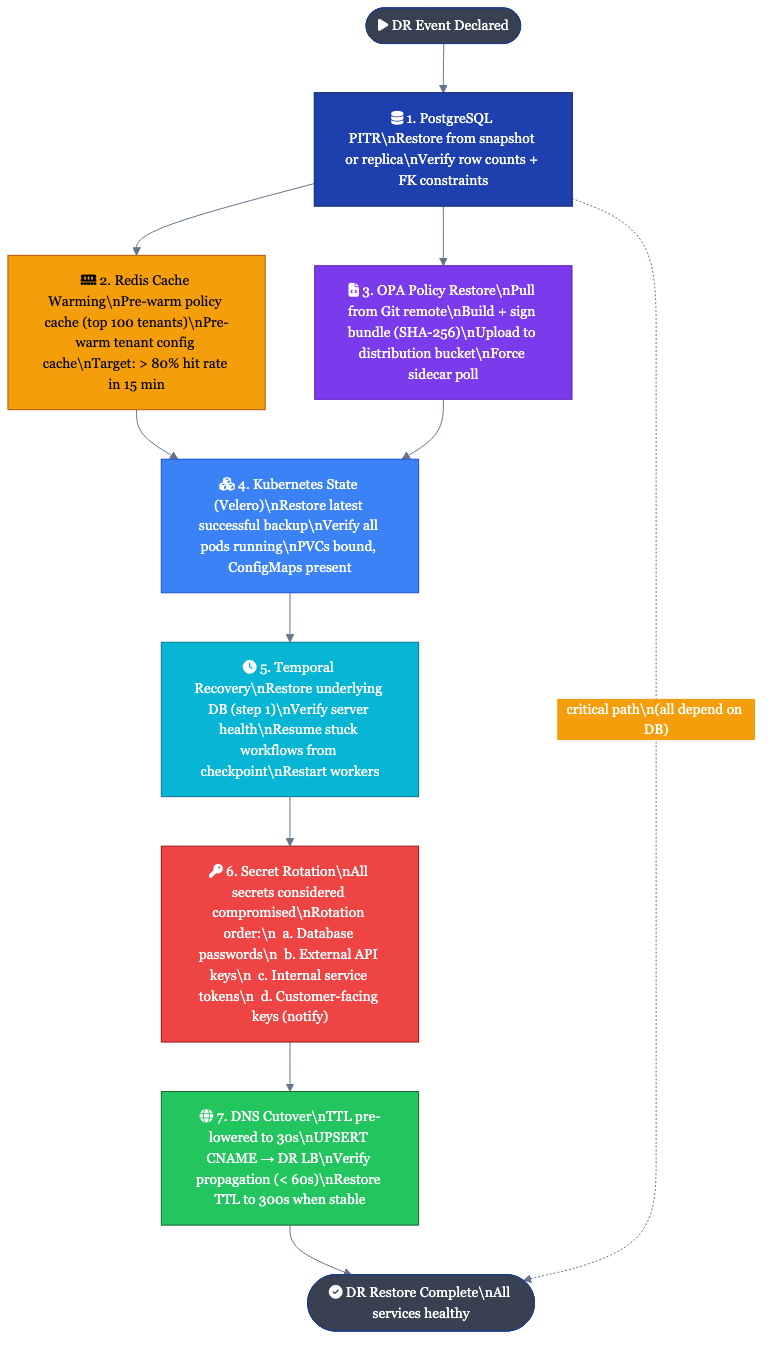
1. PostgreSQL Point-in-Time Recovery
# AWS RDS PITR
aws rds restore-db-instance-to-point-in-time \
  --source-db-instance-identifier aegis-primary \
  --target-db-instance-identifier aegis-restore-$(date +%Y%m%d%H%M) \
  --restore-time "2026-02-27T14:30:00Z" \
  --db-instance-class db.r6g.large \
  --no-multi-az \
  --tags Key=purpose,Value=dr-restore

# Wait for available status
aws rds wait db-instance-available \
  --db-instance-identifier aegis-restore-$(date +%Y%m%d%H%M)

# Verify row counts post-restore
psql $RESTORE_DSN -c "
  SELECT
    'findings' AS table_name, COUNT(*) AS rows FROM findings
  UNION ALL
  SELECT 'tenants', COUNT(*) FROM tenants
  UNION ALL
  SELECT 'audit_logs', COUNT(*) FROM audit_logs;
"
Verification Checklist — PostgreSQL:
- Row counts within expected range (compare to pre-incident snapshot)
- Latest finding timestamp within RPO window (< 5 min of incident)
- All foreign key constraints valid (
pg_constraintcheck) - pgaudit logging active on restored instance
- Connection pooler (PgBouncer) updated to point to restored instance
- Application connection test:
aegis-api health --check-db
2. Redis Cache Warming Strategy
Redis is treated as a non-persistent cache. On restore, the cache is cold and will warm organically as traffic is served. However, certain hot-path caches can be pre-warmed to reduce initial latency spike.
# Step 1: Verify Redis is reachable
redis-cli -h $REDIS_HOST ping

# Step 2: Pre-warm policy decision cache (most critical for latency)
# Run the policy warm-up job; reads top-N tenants from DB and pre-evaluates
kubectl -n aegis exec deploy/aegis-worker -- \
  aegis-cli cache warm-policies --top-tenants 100

# Step 3: Pre-warm tenant config cache
kubectl -n aegis exec deploy/aegis-worker -- \
  aegis-cli cache warm-tenants

# Step 4: Monitor cache hit rate
redis-cli -h $REDIS_HOST info stats | grep keyspace_hits
# Target: > 80% hit rate within 15 minutes of warm-up
Verification Checklist — Redis:
- Redis cluster up:
redis-cli cluster info | grep cluster_state:ok - Policy cache warm-up job completed without errors
- API latency p99 within SLA after warm-up (< 500ms)
3. OPA Policy Bundle Restore from Git
OPA bundles are the source of truth for all policy decisions. They are stored in Git and distributed via signed bundle archives. Restore is a pull from Git, not a backup restore.
# Step 1: Verify Git remote is reachable
git -C /opt/aegis/policies ls-remote origin

# Step 2: Pull latest policy bundle
git -C /opt/aegis/policies fetch --all
git -C /opt/aegis/policies checkout origin/main -- .

# Step 3: Build and sign bundle
opa build -b /opt/aegis/policies -o bundle.tar.gz
openssl dgst -sha256 -sign /etc/aegis/bundle-signing-key.pem \
  bundle.tar.gz > bundle.tar.gz.sig

# Step 4: Upload to bundle distribution endpoint
aws s3 cp bundle.tar.gz s3://$OPA_BUNDLE_BUCKET/aegis/bundle.tar.gz
aws s3 cp bundle.tar.gz.sig s3://$OPA_BUNDLE_BUCKET/aegis/bundle.tar.gz.sig

# Step 5: Force immediate poll on all OPA sidecars
kubectl -n aegis rollout restart deploy/aegis-opa

# Step 6: Verify bundle loaded
kubectl -n aegis exec deploy/aegis-opa -- \
  curl -s http://localhost:8181/v1/data/aegis | jq '.result | keys'
Verification Checklist — OPA:
- Bundle SHA matches Git HEAD:
opa inspect bundle.tar.gz | grep revision - All expected policy namespaces present in
GET /v1/data/aegis - Policy decision test:
opa eval -d bundle.tar.gz 'data.aegis.aws.s3.deny' - Decision log shipping to Kafka:
kafka-console-consumer --topic opa-decisions
4. Kubernetes State Restore (Velero)
# Step 1: List available backups
velero backup get --namespace velero | grep aegis

# Step 2: Restore latest successful backup
BACKUP_NAME=$(velero backup get --namespace velero -o json | \
  jq -r '.items | map(select(.status.phase=="Completed")) |
         sort_by(.metadata.creationTimestamp) | last | .metadata.name')

velero restore create aegis-restore-$(date +%Y%m%d%H%M) \
  --from-backup $BACKUP_NAME \
  --namespace-mappings aegis:aegis \
  --wait

# Step 3: Verify restore status
velero restore describe aegis-restore-* | grep -E "Phase|Errors|Warnings"

# Step 4: Check all pods are running
kubectl -n aegis get pods --watch
# Wait for all pods: Running, 0 restarts
Velero Backup Schedule (configured in cluster):
apiVersion: velero.io/v1
kind: Schedule
metadata:
  name: aegis-hourly
  namespace: velero
spec:
  schedule: "0 */4 * * *"
  template:
    includedNamespaces:
      - aegis
    storageLocation: default
    ttl: 168h0m0s   # 7 days
    snapshotVolumes: true
Verification Checklist — Kubernetes:
- All deployments at expected replica count
- All pods pass readiness probes
- PersistentVolumeClaims bound
- ConfigMaps and Secrets present
- Service endpoints resolving
5. Temporal Workflow State Recovery
# Step 1: Restore Temporal namespace from backup
# Temporal uses Cassandra or PostgreSQL as backend; backup is DB-level

# If using Temporal Cloud (SaaS): namespace is managed; contact Temporal support
# If self-hosted: restore underlying Cassandra/PostgreSQL first, then restart Temporal server

# Step 2: Verify Temporal server is healthy
tctl --address $TEMPORAL_ADDR cluster health

# Step 3: Check open workflows
tctl --namespace aegis workflow list --status open | head -20

# Step 4: Identify workflows stuck due to worker unavailability
tctl --namespace aegis workflow list \
  --status open --query "WorkflowType='RemediationWorkflow'" | wc -l

# Step 5: Resume stuck workflows (workers reconnect automatically once running)
# Workflows paused during outage will resume from last checkpoint on worker restart
kubectl -n aegis rollout restart deploy/aegis-worker

# Step 6: Verify workflow progress
tctl --namespace aegis workflow list --status running | \
  awk '{print $1}' | head -5 | while read wf_id; do
    tctl --namespace aegis workflow show --workflow_id $wf_id | tail -5
  done
Verification Checklist — Temporal:
- Temporal server healthy:
tctl cluster healthreturns OK - All namespaces registered:
tctl namespace list - Worker task queue polled: check worker log
"Started polling taskQueue" - No workflows in
WORKFLOW_EXECUTION_STATUS_TIMED_OUT> 5 min after restore - Cron workflows rescheduled (check next scheduled run time)
6. Secret Rotation Post-Restore
After any DR event, all secrets are considered potentially compromised and must be rotated.
# Rotation order (dependency-aware):
# 1. Database passwords  (other services depend on these)
# 2. API keys (external providers)
# 3. Internal service tokens
# 4. Customer-facing API keys (notify customers)

# Step 1: Rotate DB password
aws secretsmanager rotate-secret \
  --secret-id aegis/postgresql/password \
  --rotation-lambda-arn $ROTATION_LAMBDA_ARN

# Step 2: Rotate AI provider key (Anthropic API key)
# Generate new key in Anthropic console, then:
aws secretsmanager put-secret-value \
  --secret-id aegis/ai/anthropic-api-key \
  --secret-string "$NEW_ANTHROPIC_KEY"

# Step 3: Restart services to pick up new secrets (if using static secret mounts)
kubectl -n aegis rollout restart deploy/aegis-api
kubectl -n aegis rollout restart deploy/aegis-worker

# Step 4: Verify new secrets are active
kubectl -n aegis exec deploy/aegis-api -- \
  aegis-cli auth test --all-providers
Verification Checklist — Secrets:
- All rotated secrets marked with
rotated_attag in Secrets Manager - Old secret versions disabled (not deleted — needed for audit)
- All services restarted and healthy post-rotation
- External API keys tested (DB, AI provider, GRC integrations)
- Customer API keys rotated (if customer keys were in scope); customers notified
7. DNS Cutover Procedures
# Pre-cutover: lower TTL 24 hours before planned failover
# Set TTL to 30 seconds on primary A/CNAME records

# AWS Route 53 — switch to DR
aws route53 change-resource-record-sets \
  --hosted-zone-id $ZONE_ID \
  --change-batch '{
    "Changes": [{
      "Action": "UPSERT",
      "ResourceRecordSet": {
        "Name": "api.cloudforge.lvonguyen.com",
        "Type": "CNAME",
        "TTL": 30,
        "ResourceRecords": [{"Value": "'$DR_LOAD_BALANCER_DNS'"}]
      }
    }]
  }'

# Verify propagation (wait up to 60s)
for i in {1..12}; do
  RESOLVED=$(dig +short api.cloudforge.lvonguyen.com)
  echo "[$i] api.cloudforge.lvonguyen.com -> $RESOLVED"
  [ "$RESOLVED" = "$DR_LOAD_BALANCER_DNS" ] && echo "Propagated" && break
  sleep 5
done

# Post-failover: restore TTL to 300s (after confirming DR is stable)
Verification Checklist — DNS:
- DNS resolves to DR endpoint from 3+ geographic locations (use
digfrom different regions) - TLS certificate valid for DR endpoint (
openssl s_client -connect api.cloudforge.lvonguyen.com:443) - Synthetic monitor passes from DR endpoint (Checkly check green)
- CDN cache purged and serving from DR origin
Failover Procedures
Automated Failover (RTO: 30 min)
Triggers:
- Primary region health check fails 3 consecutive times (30s interval = 90s detection)
- Database connection failure > 5 minutes
- Kubernetes API unavailable > 5 minutes
- Replication lag > 60 seconds (pre-emptive failover before data loss risk)
Automated Steps:
- Traffic Manager / Route 53 health check detects failure
- DNS weight shifted to DR endpoint (TTL: 30s)
- Temporal:
FailoverWorkflowtriggered via Temporal Cloud event - Database replica promoted (automated failover group / RDS promotion)
- K8s pods scaled up in DR region via GitOps (ArgoCD sync with
--force) - OPA bundle verified loaded in DR
- On-call notified via PagerDuty
Manual Failover (RTO: 2 hours)
- Notify stakeholders (status page update: "Investigating degraded service")
- Drain primary gracefully (
kubectl drainwith 30s grace period) - Verify DR database replication lag < target RPO
- Promote DR database (CSP-specific command; see Restore Procedures above)
- Scale up DR Kubernetes (apply manifests or trigger ArgoCD sync)
- Restore secrets if needed (see Restore Procedures §6)
- Update DNS / load balancer (see Restore Procedures §7)
- Verify OPA policies loaded in DR
- Warm Redis cache (see Restore Procedures §2)
- Run smoke test suite:
make smoke-test ENV=dr - Update status page: "Service restored, monitoring"
- Document incident in Incident log (PagerDuty post-mortem)
Quarterly DR Testing
| Quarter | Test Type | Scope | Success Criteria |
|---|---|---|---|
| Q1 | Tabletop exercise | Full scenario walkthrough | All team members know roles |
| Q2 | Database failover | DB only (no traffic switch) | PITR completed < 15 min |
| Q3 | Full failover simulation | Complete (traffic + DB + K8s) | RTO met, zero data loss |
| Q4 | Chaos engineering | Random component injection | System self-heals within RTO |
DR Test Execution Checklist
Before Test:
- Notify all stakeholders (test window agreed; no production changes during test)
- Pre-check: primary region fully healthy
- Pre-check: DR region cold (0 pods, DB in replica state)
- Baseline metrics captured (current p99 latency, finding count, audit log tail)
During Test:
- Simulate failure (block traffic or terminate primary nodes)
- Track time from failure injection to automated detection
- Track time from detection to DR serving traffic
- Verify all verification checklists in Restore Procedures section
After Test:
- Confirm RTO met (< 2 hours manual, < 30 min automated)
- Confirm RPO met (< 5 min data loss)
- OPA policies functional in DR
- GRC integrations restored
- Template deployments working
- Rollback to primary successful
- Test report filed in incident management system
- Action items for any failures logged as P2 tickets
Data Retention & Archival
Retention Schedule by Data Type
| Data Type | Active Retention | Archive Retention | Total | Trigger |
|---|---|---|---|---|
| Findings (standard) | 2 years (hot) | 5 years (cold) | 7 years | Compliance default |
| Findings (SOX tenants) | 2 years (hot) | 5 years (cold) | 7 years | SOX § 802 |
| Findings (HIPAA tenants) | 2 years (hot) | 4 years (cold) | 6 years | HIPAA 45 CFR § 164 |
| Audit logs | 1 year (hot) | 6 years (cold) | 7 years | SOX / PCI requirement |
| Remediation state snapshots | 90 days (hot) | 275 days (cold) | 1 year | Operational |
| Policy decision logs (OPA) | 90 days (hot) | 275 days (cold) | 1 year | Operational |
| Session / access logs | 90 days (hot) | 9 months (cold) | 1 year | PCI Req 10.7 |
| Customer-uploaded configs | Indefinite (active) | Archived on tenant offboard | — | Contract |
| Backup snapshots | 30 days (daily) | 11 months (monthly) | 1 year | Operational |
Archival Storage Tiers by CSP
| CSP | Active (Hot) | Archive (Cold) | Deep Archive | Retrieval Time (Deep) |
|---|---|---|---|---|
| AWS | S3 Standard | S3-IA / Glacier Instant | S3 Glacier Flexible Retrieval | 3-5 hours |
| Azure | Blob Hot | Blob Cool | Blob Archive | 15+ hours |
| GCP | GCS Standard | GCS Nearline | GCS Coldline | Minutes (Coldline) |
Data Lifecycle Automation
AWS S3 Lifecycle Policy (applied to aegis-findings-{tenant} buckets):
{
  "Rules": [
    {
      "ID": "findings-lifecycle",
      "Status": "Enabled",
      "Filter": { "Prefix": "findings/" },
      "Transitions": [
        { "Days": 730,  "StorageClass": "STANDARD_IA" },
        { "Days": 1825, "StorageClass": "GLACIER_IR" }
      ],
      "Expiration": { "Days": 2555 }
    },
    {
      "ID": "audit-log-lifecycle",
      "Status": "Enabled",
      "Filter": { "Prefix": "audit-logs/" },
      "Transitions": [
        { "Days": 365,  "StorageClass": "STANDARD_IA" },
        { "Days": 730,  "StorageClass": "GLACIER_IR" }
      ],
      "Expiration": { "Days": 2555 }
    }
  ]
}
GCP GCS Lifecycle Policy:
{
  "lifecycle": {
    "rule": [
      {
        "action": { "type": "SetStorageClass", "storageClass": "NEARLINE" },
        "condition": { "age": 730 }
      },
      {
        "action": { "type": "SetStorageClass", "storageClass": "COLDLINE" },
        "condition": { "age": 1825 }
      },
      {
        "action": { "type": "Delete" },
        "condition": { "age": 2555 }
      }
    ]
  }
}
PostgreSQL Archival (findings table):
-- Scheduled via Temporal cron: runs monthly at 03:00 UTC
-- Archives findings older than 2 years to cold storage table

INSERT INTO findings_archive
  SELECT * FROM findings
  WHERE created_at < NOW() - INTERVAL '2 years'
    AND archived_at IS NULL;

UPDATE findings
  SET archived_at = NOW()
  WHERE created_at < NOW() - INTERVAL '2 years'
    AND archived_at IS NULL;

-- findings_archive is backed up to Glacier/Coldline via separate lifecycle rule
-- findings table retains only active records (last 2 years) for query performance
Deletion and Erasure
- Standard deletion: findings soft-deleted (deleted_at timestamp); hard-deleted after 90 days
- GDPR erasure: immediate hard delete + audit record (see GDPR section)
- Tenant offboarding: all tenant data deleted within 30 days of contract termination; certificate of deletion issued
- Backup purge: expired backups deleted per lifecycle policy; S3 Object Lock prevents premature deletion for SOX/HIPAA tenants
DR Cost Summary (Monthly)
| Component | AWS | Azure | GCP |
|---|---|---|---|
| K8s standby (pre-provisioned nodes) | $75 | $0 | $75 |
| Database replica | $150 | $140 | $130 |
| Storage replication | $25 | $25 | $20 |
| Velero backup storage | $10 | $10 | $8 |
| Cross-region data transfer | $20 | $15 | $15 |
| Total (same-CSP DR) | $280 | $190 | $248 |
| Cross-cloud replication (pg_logical + rclone) | +$50 | +$50 | +$50 |
| Total (cross-cloud DR enabled) | $330 | $240 | $298 |
Notes:
- FedRAMP GovCloud adds ~30% premium to AWS line items
- PCI/HIPAA HSM costs (CloudHSM / Dedicated HSM): +$1,500-$2,000/month per CSP
- Platinum SLA (99.99%) requires active-active architecture: ~3x standard DR cost
Document History
| Version | Date | Author | Changes |
|---|---|---|---|
| 1.0 | January 2026 | Liem Vo-Nguyen | Initial release |
| 2.0 | February 27, 2026 | Liem Vo-Nguyen | Global deployment architecture, compliance-driven models (GDPR/PCI/HIPAA/SOX/FedRAMP), enhanced SLA targets, detailed restore procedures, data retention & archival, cross-cloud failover matrix |
| 2.1 | March 20, 2026 | Liem Vo-Nguyen | Renamed CloudForge to CloudForge; deployment tier naming refresh |
Author
Liem Vo-Nguyen
- LinkedIn: linkedin.com/in/liemvonguyen