CSPM Aggregator - Detailed Design Document (DDD)
Document Control
| Version | Date | Author | Role | Contact |
|---|---|---|---|---|
| 1.0 | 8 January 2026 | Liem Vo-Nguyen | Security Architect | [email protected] |
Table of Contents
| Section | Page |
|---|---|
| Architecture Decision Records | 1 |
| Data Flow Diagrams | 6 |
| Component Design | 7 |
| API Specifications | 9 |
| Data Models | 11 |
| AI Scoring Design | 13 |
| Security Design | 16 |
| Appendix: Technology References | 18 |
Architecture Decision Records
ADR-001: Language Selection
Status: Accepted Date: 8 January 2026
Context: Need to choose a language for the aggregator service that handles multi-cloud API calls, JSON processing, and LLM integration.
Options:
| Option | Pros | Cons |
|---|---|---|
| Go | Single binary, fast startup, strong typing, excellent concurrency | Verbose error handling |
| Python | Rich AI/ML ecosystem, rapid prototyping | Slower startup, dependency management |
| Rust | Memory safety, performance | Steep learning curve, slower development |
Decision: Go
Rationale:
- Single binary deployment simplifies container images
- Fast cold start ideal for CronJob workloads
- Strong typing catches errors at compile time
- Excellent cloud SDK support (AWS, Azure, GCP)
- Go 1.23+ generics improve code reuse
ADR-002: AI Provider Selection
Status: Accepted Date: 8 January 2026
Context: Need an LLM provider for contextual risk scoring and complexity assessment fallback.
Options:
| Option | Pros | Cons |
|---|---|---|
| Anthropic Claude | Superior reasoning, JSON mode, safety | API-only, no self-host |
| OpenAI GPT-4 | Wide adoption, function calling | Rate limits, cost |
| AWS Bedrock | Managed, multiple models | AWS lock-in, complexity |
| Self-hosted (Llama) | No API costs, privacy | Ops overhead, quality gap |
Decision: Anthropic Claude (claude-opus-4-6)
Rationale:
- Best-in-class reasoning for complex security context
- Native JSON output mode reduces parsing errors
- Consistent, deterministic output at low temperature (0.1)
- Strong safety alignment for security-sensitive prompts
ADR-003: Authentication Strategy
Status: Accepted Date: 8 January 2026
Context: Need to authenticate to three cloud providers without storing credentials.
Decision: Federated Identity (OIDC/MSI/WIF)
| Cloud | Method | Token Lifetime |
|---|---|---|
| AWS | OIDC Federation via STS | 1 hour |
| Azure | Managed Identity | Automatic |
| GCP | Workload Identity Federation | 1 hour |
Rationale:
- Zero credential storage eliminates secret rotation burden
- Audit trail via cloud-native identity logs
- Automatic token refresh handled by SDKs
- Aligned with zero-trust architecture
ADR-004: Deployment Model
Status: Accepted Date: 8 January 2026
Context: Need to run the aggregator on a schedule (monthly) with minimal operational overhead.
Options:
| Option | Pros | Cons |
|---|---|---|
| Kubernetes CronJob | Native scheduling, resource limits | Requires cluster |
| Azure Functions (Timer) | Serverless, pay-per-use | Cold start, 10-min limit |
| AWS Lambda + EventBridge | Serverless | 15-min limit, cross-cloud auth complex |
| VM + cron | Simple | Always-on cost, manual patching |
Decision: Kubernetes CronJob on AKS
Rationale:
- Native Workload Identity integration for Azure
- No execution time limits (job can run 1+ hours)
- Resource limits and pod security policies
- Reuse existing AKS infrastructure
ADR-005: State Storage
Status: Accepted Date: 8 January 2026
Context: Need to persist state between runs for delta detection (NEW/EXISTING/CLOSED/REOPENED).
Options:
| Option | Cost | Durability | Complexity |
|---|---|---|---|
| Azure Blob Storage | $0.02/GB | 99.999999999% (11 9s) | Low |
| Azure Table Storage | $0.04/GB | 99.999999999% | Low |
| PostgreSQL | $25+/mo | High | Medium |
| Redis | $15+/mo | Medium | Low |
Decision: Azure Blob Storage
Rationale:
- Cheapest option for small state files (<1 MB)
- 11 9s durability with GRS replication
- Simple JSON file read/write (no ORM)
- Managed Identity authentication
ADR-006: Complexity Assessment Strategy
Status: Accepted Date: 8 January 2026
Context: Need to classify findings into remediation complexity tiers (Tier1/2/3).
Decision: Rule-based with AI fallback
Strategy:
1. Try rule-based matching (25+ predefined rules)
   -> Match found -> Return tier

2. AI fallback for unknown finding types
   -> LLM assesses complexity
   -> Return tier with lower confidence

3. Conservative default
   -> Unknown + AI unavailable -> Tier3
Rationale:
- Rules provide deterministic, fast classification for known patterns
- AI handles novel/edge cases without manual rule updates
- Conservative default ensures no underestimation of effort
ADR-007: Priority Matrix Design
Status: Accepted Date: 8 January 2026
Context: Need to combine risk severity and remediation complexity into actionable priorities.
Decision: 2D Matrix with Escalation Rules
Base Matrix:
| Tier 1 | Tier 2 | Tier 3 | |
|---|---|---|---|
| CRITICAL | P1 | P1 | P2 |
| HIGH | P1 | P2 | P3 |
| MEDIUM | P3 | P4 | P4 |
| LOW | P4 | P5 | P5 |
Escalation Rules (can bump priority up):
- Production environment: +1 priority (max P1)
- PCI/PII data: +1 priority (max P2)
- Internet-facing resource: +1 priority (max P2)
- SLA overdue: +1 priority
Rationale:
- Simple mental model for security teams
- Escalations capture business context
- Maps cleanly to SLA timelines (P1=24h, P2=7d, P3=14d, P4=30d, P5=90d)
ADR-008: Container Security
Status: Accepted Date: 8 January 2026
Context: Need to secure the container workload running in AKS.
Decision: Defense in Depth
| Control | Setting |
|---|---|
| Non-root user | runAsUser: 1000 |
| Read-only filesystem | readOnlyRootFilesystem: true |
| No privilege escalation | allowPrivilegeEscalation: false |
| Drop all capabilities | capabilities: { drop: [ALL] } |
| Resource limits | cpu: 1000m, memory: 1Gi |
Rationale:
- Non-root prevents privilege escalation exploits
- Read-only filesystem limits persistence mechanisms
- Dropped capabilities reduce kernel attack surface
- Resource limits prevent DoS from runaway processes
ADR-009: Network Policy
Status: Accepted Date: 8 January 2026
Context: Need to restrict network access for the aggregator pod.
Decision: Egress-only to DNS and HTTPS
egress:
  - ports: [53/UDP, 53/TCP]  # DNS
  - ports: [443/TCP]          # HTTPS
    to:
      - ipBlock:
          cidr: 0.0.0.0/0
          except:
            - 10.0.0.0/8
            - 172.16.0.0/12
            - 192.168.0.0/16
Rationale:
- DNS required for service discovery
- HTTPS required for cloud APIs and LLM
- Exclude private ranges to prevent lateral movement
- No ingress required (batch job, not server)
Data Flow Diagrams
Scoring Pipeline
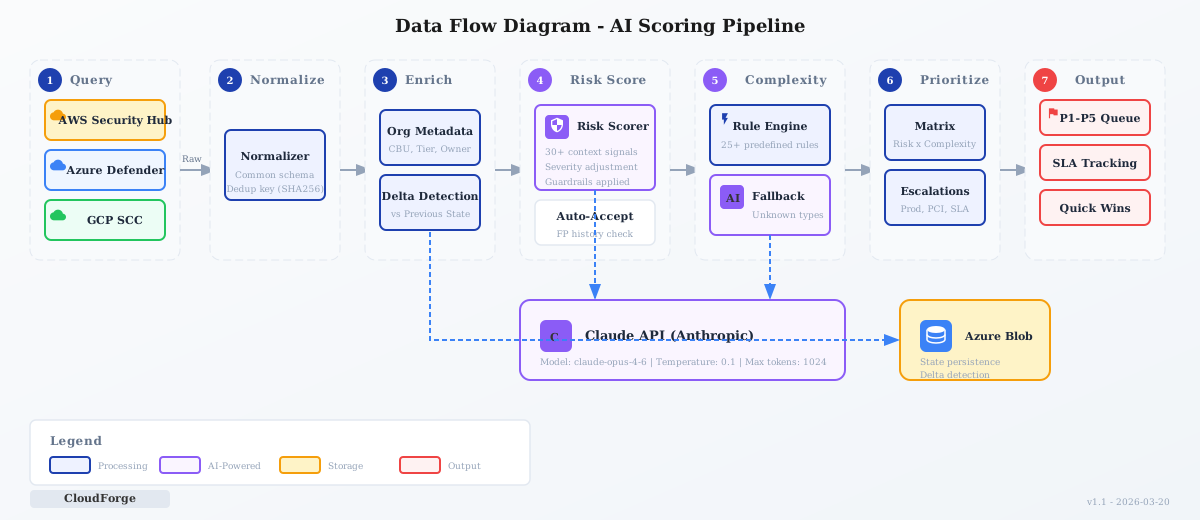
Shows: Cloud providers -> Normalizer -> Delta Detection -> AI Scoring -> Priority Matrix -> Outputs
Priority Matrix Flow
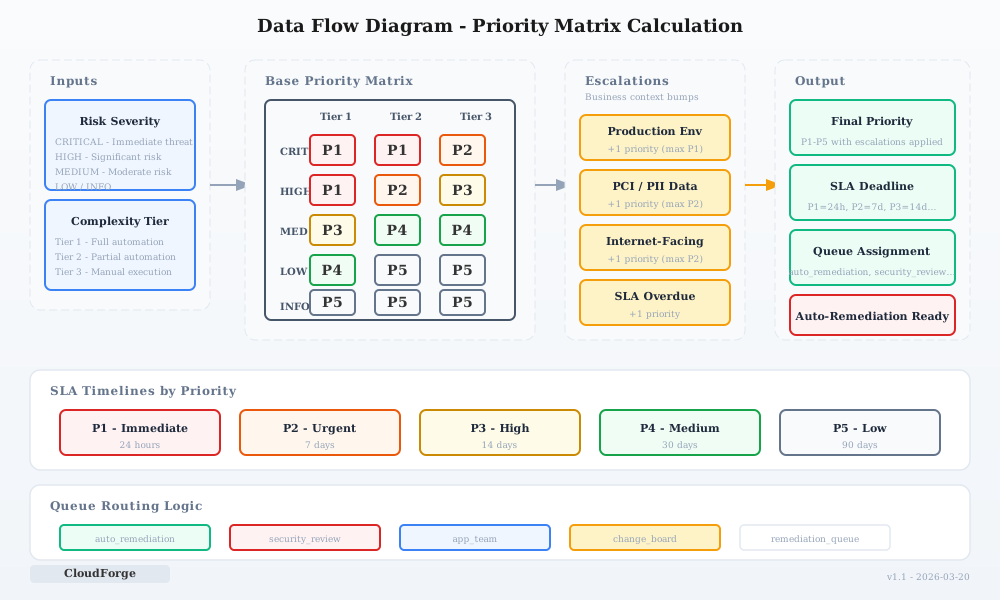
Shows: Risk severity + Complexity tier -> Base priority -> Escalation rules -> Final priority + SLA
Component Design
Package Structure
cspm-aggregator/
├── cmd/aggregator/          # Application entrypoint
│   └── main.go              # CLI flags, pipeline orchestration
├── internal/
│   ├── config/              # Configuration management
│   │   └── config.go        # YAML + env var loading
│   ├── providers/           # Cloud provider clients
│   │   ├── aws/securityhub.go
│   │   ├── azure/defender.go
│   │   └── gcp/scc.go
│   ├── normalizer/          # Common finding schema
│   │   └── schema.go        # Finding struct, delta detection
│   ├── scoring/             # AI scoring layer
│   │   ├── risk_scorer.go   # Contextual risk assessment
│   │   ├── complexity.go    # Remediation tier classification
│   │   └── priority.go      # Priority matrix calculation
│   ├── asana/               # Asana task sync
│   ├── email/               # Email notifications
│   └── reporter/            # Report generation
├── configs/config.yaml      # Configuration template
└── k8s/                     # Kubernetes manifests
Interface Definitions
Cloud Provider Interface:
type Provider interface {
    Name() string
    GetFindings(ctx context.Context) ([]normalizer.Finding, error)
}
LLM Provider Interface:
type LLMProvider interface {
    Complete(ctx context.Context, req CompletionRequest) (*CompletionResponse, error)
    Stream(ctx context.Context, req CompletionRequest) (<-chan StreamChunk, error)
    CountTokens(ctx context.Context, text string) (int, error)
    ModelName() string
    MaxContextLength() int
    IsAvailable(ctx context.Context) bool
}
Metadata Provider Interface:
type ResourceMetadataProvider interface {
    GetDependencyCount(ctx context.Context, resourceID string) (int, error)
    IsStateful(ctx context.Context, resourceID, resourceType string) (bool, error)
    IsSharedResource(ctx context.Context, resourceID string) (bool, error)
    GetSLATier(ctx context.Context, resourceID string) (string, error)
}
API Specifications
CLI Interface
# Full pipeline execution
./aggregator --config /app/configs/config.yaml

# Dry run (no external writes)
./aggregator --dry-run

# Single cloud provider
./aggregator --cloud aws

# Version info
./aggregator --version
Planned HTTP API (v1.1)
Get Prioritized Findings:
GET /api/v1/findings
  ?priority=P1,P2
  &severity=CRITICAL,HIGH
  &tier=Tier1
  &automation_candidate=true
  &queue=auto_remediation
  &sla_status=overdue
  &csp=aws,azure
  &cbu=BRAND1,BRAND2
  &limit=100
  &cursor=xxx

Response:
{
  "findings": [PrioritizedFinding],
  "summary": {
    "total": 150,
    "by_priority": {"P1": 5, "P2": 20, "P3": 45, "P4": 60, "P5": 20},
    "auto_remediation_ready": 12,
    "quick_win_risk_reduction_pct": 35.5
  },
  "next_cursor": "yyy"
}
Dashboard Summary:
GET /api/v1/dashboard/summary

Response:
{
  "total_findings": 150,
  "p1_count": 5,
  "p2_count": 20,
  "p3_count": 45,
  "p4_count": 60,
  "p5_count": 20,
  "auto_remediation_ready": 12,
  "quick_wins": 8,
  "quick_win_risk_reduction_pct": 35.5,
  "on_track_sla": 120,
  "at_risk_sla": 20,
  "overdue_sla": 10,
  "trend": {
    "new_findings": 25,
    "closed_findings": 40,
    "net_change": -15,
    "closure_rate": 0.62
  }
}
Quick Wins Report:
GET /api/v1/reports/quick-wins

Response:
{
  "quick_wins": [
    {
      "finding_id": "xxx",
      "title": "S3 bucket public access",
      "priority": "P1",
      "tier": "Tier1",
      "automation_candidate": true,
      "estimated_effort_hours": 0.5,
      "risk_reduction_pct": 5.2
    }
  ],
  "total_risk_reduction_pct": 35.5
}
Data Models
Common Finding Schema
type Finding struct {
    // Core identification
    FindingID       string    `json:"finding_id"`
    FindingIDShort  string    `json:"finding_id_short"`  // SHA256 dedup key
    CSP             string    `json:"csp"`               // aws|azure|gcp
    AccountID       string    `json:"account_id"`
    ResourceID      string    `json:"resource_id"`

    // Details
    Title           string    `json:"title"`
    Description     string    `json:"description"`
    Severity        string    `json:"severity"`          // CRITICAL|HIGH|MEDIUM|LOW
    Status          string    `json:"status"`            // ACTIVE|RESOLVED|SUPPRESSED
    ControlID       string    `json:"control_id"`
    Standard        string    `json:"standard"`          // CIS|FSBP|MCSB

    // Classification (from org metadata)
    CBU             string    `json:"cbu"`               // Cost Business Unit
    Tier            string    `json:"tier"`              // Tier1-Prod|Tier2-NonProd|Tier3-Dev
    EnvType         string    `json:"env_type"`          // DEV|STG|PROD
    Owner           string    `json:"owner"`

    // Timestamps
    FirstSeen       time.Time `json:"first_seen"`
    LastSeen        time.Time `json:"last_seen"`
    RemediationSLA  time.Time `json:"remediation_sla"`

    // Tracking
    AsanaTaskID     string    `json:"asana_task_id,omitempty"`
    DeltaStatus     string    `json:"delta_status"`      // NEW|EXISTING|CLOSED|REOPENED
    DaysOpen        int       `json:"days_open"`
}
Risk Assessment
type RiskAssessment struct {
    OriginalSeverity   string   `json:"original_severity"`
    AdjustedSeverity   string   `json:"adjusted_severity"`
    SeverityDirection  string   `json:"severity_direction"`  // upgraded|downgraded|unchanged
    RiskScore          int      `json:"risk_score"`          // 1-100
    Confidence         float64  `json:"confidence"`          // 0.0-1.0
    Rationale          string   `json:"rationale"`
    MitigatingFactors  []string `json:"mitigating_factors"`
    AggravatingFactors []string `json:"aggravating_factors"`
    RecommendedAction  string   `json:"recommended_action"`  // remediate|accept_risk|investigate|suppress
    AutoAcceptEligible bool     `json:"auto_accept_eligible"`
    AutoAcceptReason   string   `json:"auto_accept_reason,omitempty"`
}
Complexity Assessment
type ComplexityAssessment struct {
    Tier                 int      `json:"tier"`                   // 1|2|3
    ComplexityScore      int      `json:"complexity_score"`       // 1-100
    AutomationCandidate  bool     `json:"automation_candidate"`
    AutomationBlockers   []string `json:"automation_blockers,omitempty"`

    // Coordination requirements
    RequiresAppTeam      bool     `json:"requires_app_team"`
    RequiresNetworkTeam  bool     `json:"requires_network_team"`
    RequiresDBTeam       bool     `json:"requires_db_team"`
    RequiresChangeWindow bool     `json:"requires_change_window"`
    RequiresDowntime     bool     `json:"requires_downtime"`

    // Impact estimates
    ServiceImpact        string   `json:"service_impact"`         // none|minimal|moderate|significant
    EstimatedDowntimeMin int      `json:"estimated_downtime_min"`
    EstimatedEffortHours float64  `json:"estimated_effort_hours"`
    RecommendedApproach  string   `json:"recommended_approach"`
    Rationale            string   `json:"rationale"`
}
Prioritized Finding
type PrioritizedFinding struct {
    Finding              Finding              `json:"finding"`
    RiskAssessment       RiskAssessment       `json:"risk_assessment"`
    ComplexityAssessment ComplexityAssessment `json:"complexity_assessment"`

    // Priority output
    Priority             string   `json:"priority"`              // P1|P2|P3|P4|P5
    EscalationReasons    []string `json:"escalation_reasons,omitempty"`
    Queue                string   `json:"queue"`                 // auto_remediation|security_review|app_team|change_board|remediation_queue
    AutoRemediationReady bool     `json:"auto_remediation_ready"`

    // SLA tracking
    SLADeadline          time.Time `json:"sla_deadline"`
    SLAStatus            string    `json:"sla_status"`           // on_track|at_risk|overdue
    DaysUntilSLA         int       `json:"days_until_sla"`
}
AI Scoring Design
Risk Scorer Architecture
Context Signals (30+):
| Category | Signals |
|---|---|
| Asset Classification | AssetTier, EnvType, DataClassification, BusinessCriticality |
| Network Exposure | InternetFacing, VPCType, IngressPorts, EgressRestricted |
| Compensating Controls | WAFEnabled, EDREnabled, DLPEnabled, EncryptionAtRest, EncryptionInTransit, MFARequired, PrivateEndpoint |
| Vulnerability Context | CVSSScore, ExploitAvailable, ExploitInWild, PackageInUse, PatchAvailable |
| Historical Patterns | FalsePositiveHistory, FPRateForType |
| Business Context | ComplianceScopes, DataResidency, CostCenter, ApplicationOwner, SupportTier |
Risk Scoring Flow:
1. Enrich context from metadata providers
2. Load FP history for finding type
3. Check auto-accept scenarios:
   - LOW severity in sandbox -> auto-accept
   - High FP rate (>30%) + 3+ historical FPs -> auto-accept
4. Build LLM prompt with all context signals
5. Call Claude API (temperature=0.1)
6. Parse JSON response
7. Apply guardrails:
   - Never downgrade CRITICAL on Tier1-Prod + internet-facing
   - Minimum MEDIUM for PCI/PII data
   - Cap confidence at 70% when package usage unknown
   - Ensure risk score aligns with severity
Complexity Normalizer Rules
Tier 1 (Full Automation):
| Cloud | Finding Types |
|---|---|
| AWS | S3 public access, logging disabled, IMDSv2, tagging, CloudTrail |
| Azure | HTTPS only, diagnostic logging |
| GCP | Public bucket access, audit logging |
Tier 2 (Partial Automation):
| Cloud | Finding Types |
|---|---|
| AWS | Security groups, IAM policies, TLS config, patching |
| Azure | NSG rules, Key Vault access |
| GCP | Firewall rules, IAM bindings |
Tier 3 (Manual Execution):
| Cloud | Finding Types |
|---|---|
| AWS | RDS config, network architecture, critical patches |
| Azure | SQL configuration |
| GCP | Cloud SQL, GKE cluster configuration |
Environment Bumps:
- Production environment: +1 tier
- Stateful resource (database, queue): +1 tier
- High dependencies (>5): +1 tier
- Shared resource: Minimum Tier2, no automation
- PCI/PII/PHI data: Minimum Tier2, requires change window
Security Design
Authentication Flow
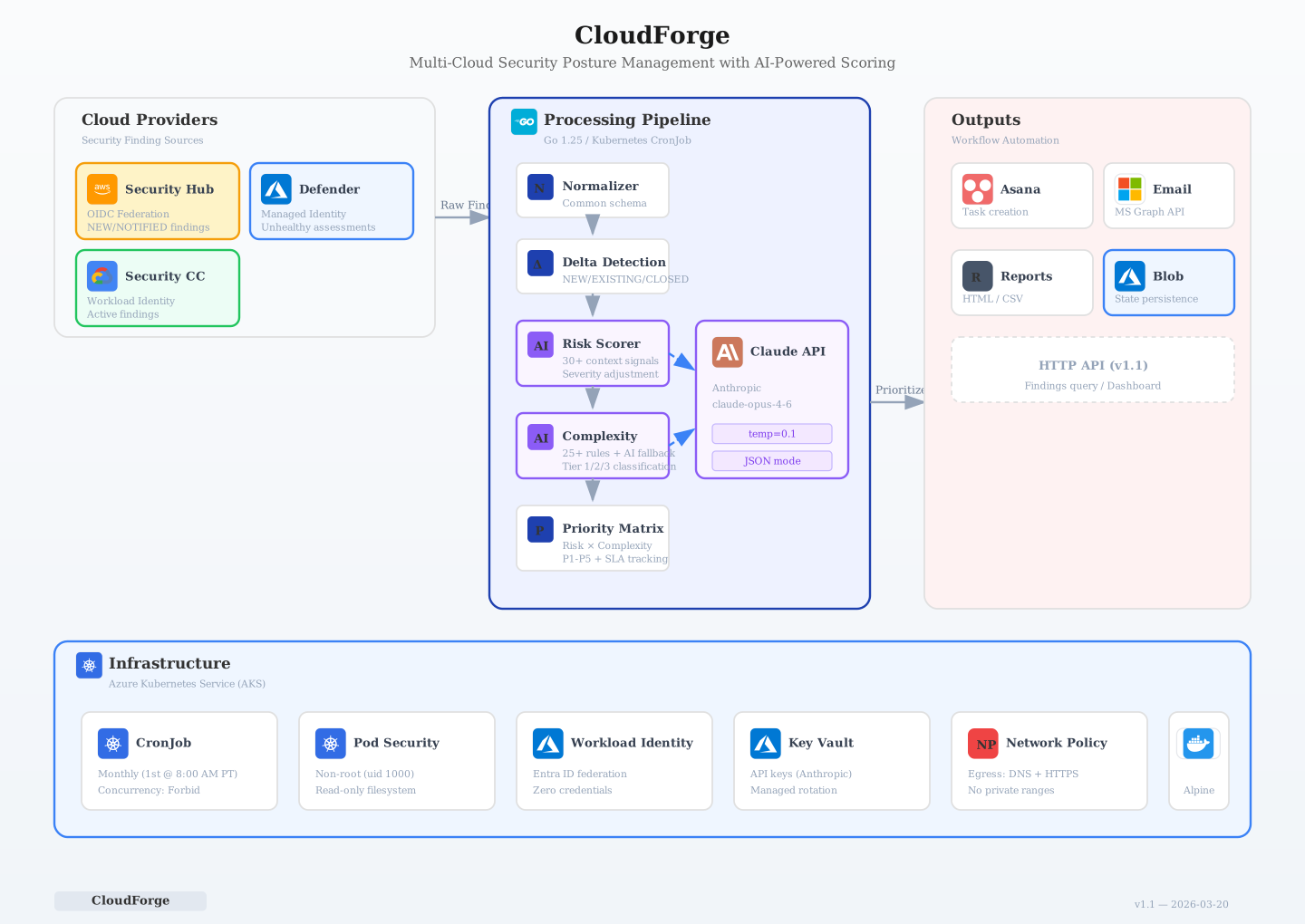
Shows: OIDC/MSI/WIF authentication to cloud providers, Key Vault for secrets
Data Access Control
| Data | Read | Write | Delete |
|---|---|---|---|
| Cloud findings | Aggregator | N/A | N/A |
| State files | Aggregator | Aggregator | Admin |
| Reports | Aggregator, Users | Aggregator | Admin |
| Config | Aggregator | Admin | Admin |
| Secrets | Aggregator | Admin | Admin |
Secrets Management
| Secret | Storage | Rotation | Access |
|---|---|---|---|
| Anthropic API Key | Key Vault | Annual | Aggregator (MSI) |
| Asana PAT | Key Vault | Annual | Aggregator (MSI) |
| Graph Client Secret | Key Vault | Annual | Aggregator (MSI) |
Audit Logging
| Event | Log Level | Fields |
|---|---|---|
| Pipeline start | INFO | timestamp, version, config_hash |
| Provider query | INFO | provider, finding_count, duration |
| AI scoring | DEBUG | finding_id, original_severity, adjusted_severity |
| External write | INFO | destination, record_count |
| Error | ERROR | operation, error_message, stack_trace |
Appendix: Technology References
| Technology | Purpose | Documentation |
|---|---|---|
| Go 1.23 | Language runtime | Official docs |
| AWS SDK for Go v2 | AWS API client | AWS docs |
| Azure SDK for Go | Azure API client | Microsoft docs |
| GCP Go Client Libraries | GCP API client | Google docs |
| Anthropic Claude | LLM API | Anthropic docs |
| Zap Logger | Structured logging | Uber docs |
| Azure Blob Storage | State persistence | Microsoft docs |
| Azure Key Vault | Secrets management | Microsoft docs |
| Kubernetes CronJob | Scheduling | K8s docs |
| Asana API | Task management | Asana docs |
| Microsoft Graph | Email API | Microsoft docs |